Here is a chart of total establishment jobs.
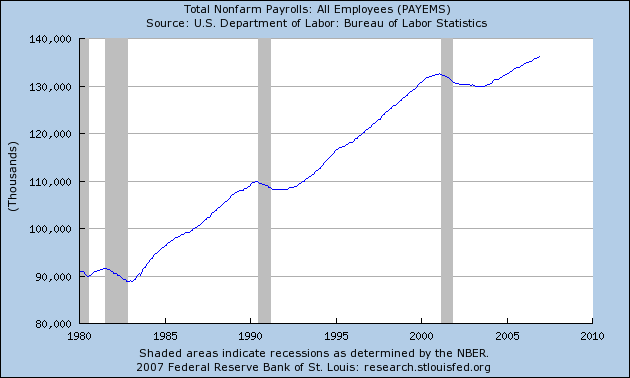
Notice that establishment jobs continue to increase until right each recession began. This indicates that monthly increases are not necessarily predictive of a continued expansion; job increases can occur right up until the beginning of a recession.
Here is a chart of year-over-year percent change:
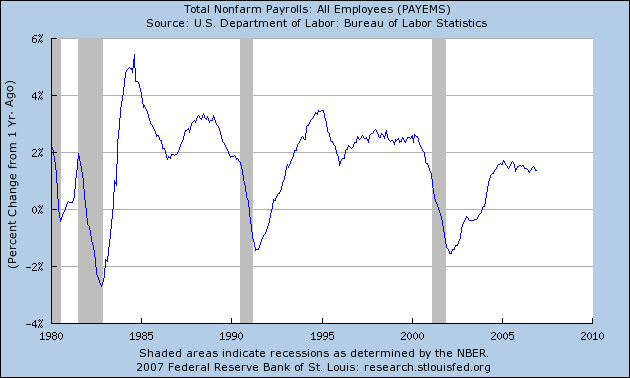
This chart gives us something more to work with. Notice how the YOY percent change dropped noticeably before the beginning of the last two recessions. Also note we haven't had a drop of similar magnitude during this expansion. That adds some strength to the soft-landing pundit's arguments.
Here is a chart of the percent change annualized rate of change:
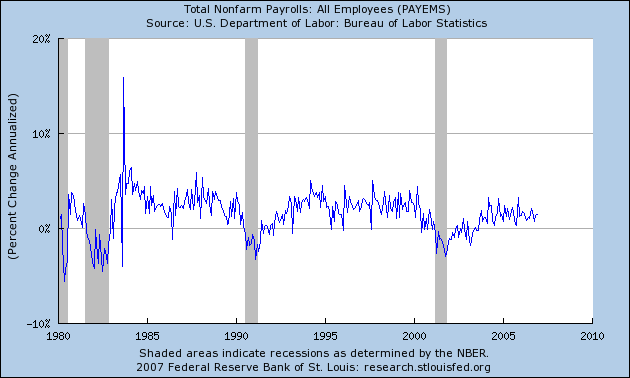
This chart has a lot of statistical noise, so it is not as solid as a predictor. However, notice that before the last two recessions, the annualized percent change hit 0%. But also notice that several times the line hit 0% and the economy didn't hit a recession. That makes this particular economic number pretty soft.
So, what do we know now that we didn't know when we started? That year-over-year percent change in establishment payrolls is probably the best employment predictor of recessions; it has dropped sharply before two of the last three recessions. In addition, this chart was last updated on January 5 when the 167,000 payrolls number came out. That means according to this statistic we aren't near a recession yet.
It's important to remember that hiring is an incredibly important business decision -- perhaps one of the most important decisions a business makes. That makes these numbers very important.
It's also important to remember there is no economic holy grail.


8 comments:
All pictures are filtered out by my provider. It doesn't look like Photobucket is a right service to use
I don't see any graphs either, and I've never had any trouble with filtering the pictures before.
On what the text says that the pictures say, though, I'd make it even simpler. Unemployment is a lagging indicator. The statistical correlation is with past GDP growth, not with future GDP growth.
So if there is strong employment growth, it has to slow down before a recession can start, because strong employment growth is a lagging indicator that GDP growth has been strong. And a recovery has got to start running out of steam before we go into pre-recessionary conditions.
But we have not had strong employment growth for most of this recovery, so those numbers are not even going to tell us that much.
The same holds true when coming out of a recession ... leading indicators turn up, and when the employment number turns up, that gives us additional info about a recovery we already suspected was underway. And then when finally unemployment numbers start dropping as employment growth catches up to discourage workers returning to the labor market, we are normally in a position to be confident that a recovery is under way.
So the $0.05 take-home advice: very strong or very weak employment numbers help color in and confirm what we already suspected, but looking into a lukewarm labor market for a leading indicator is squinting at tea leaves.
One housing front DHI MIH and BHS reported ugly numbers.
Is there another photo provider that you would recommend?
Bruce --
Regarding this expansion's employment growth..
Fed Gov. Poole gave a speech in the last few months of 2006 about this expansion's growth. His basic argument was population growth has slowed for this expansion as the first of the boomers retired. Therefore job growth doesn't have to be as high as previous expansions to keep up with population growth.
I'm still trying to figure out the jobs picture for this expansion. There are several qualities -- notably the low rate of growth plus the low unemployment rate -- that I am still thinking about. I don't have a good answer, but I think Poole's thesis is interesting.
I think Poole's thesis is delusional, and he is blowing smoke to try to make the picture prettier than it is.
People born in 1945 will just this year turn 62. Most boomers were actually born in later years, and are now younger yet. For many of these people, retiring without the benefit of age-based Social Security simply isn't an option. I doubt we will see boomers retiring en masse until 2010 at the earliest. I rather suspect that many of same will continue to work (under the table if necessary) while drawing Soc. Sec., and that the bulge of boomers leaving the workforce won't be apparent for another decade.
Sure, some people retired in the last five years. But it's delusional to think that enough boomers did well enough to retire in their 50s that such retirements would make a noticeable difference in national employment needs.
Bear in mind that Poole is a Monetarist, and any good follower of Friedman is even more comfortable with using rhetorical tricks in service of his theory than with distorting empirical results.
And in reading the November 2006 speech, there is a very clever rhetorical game being played. The downturn in participation rates that may occur in the future is discussed directly after the discussion of the fact that the participation rate has tended to slide since the turn of the century ... without coming out and saying outright that it is the cause of the changes in participation rates since 2000, but with language that suggests that it is already "part of" the decline.
Obviously, there is no reason to believe that the factors on the Baby Boomers retiring have anything whatsoever to do with the present changes in participation rates ... to the extent that it draws in Baby Boomers, they are discouraged workers who lost their jobs in their 50's and found it very hard to find new ones.
And so even the part of the change in participation rates that involve Baby Boomers are far more likely to be involved in the sluggish job growth and sluggish wage growth overall through the course of this recovery.
But, to a Monetarist, substantially higher hidden unemployment than in previous recoveries is simply an increase in the 'natural rate of unemployment'.
Post a Comment