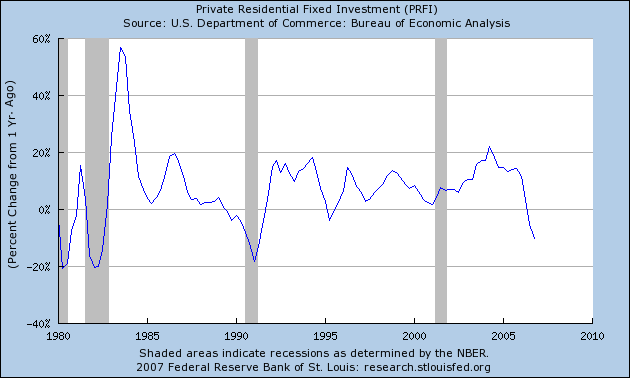
Let's break the gross number down. Once again, residential investment decreased from the preceding month, this time at a 19.2% clip. This is the third quarter in a row of declining residential investment. Below is a chart of the year over year change in residential investment. Again, this chart does not include this week's number which also would have sent the chart lower.
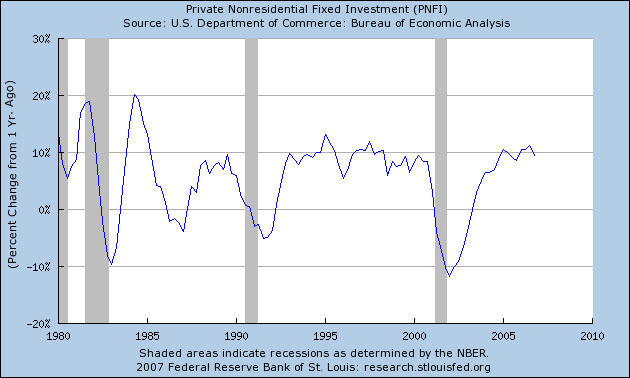
Here is a chart of non residential fixed investment. It shows a a solid year over year change. The year over year change for this figure in last week's GDP report was 7.4%. So, we are still in decent territory here.
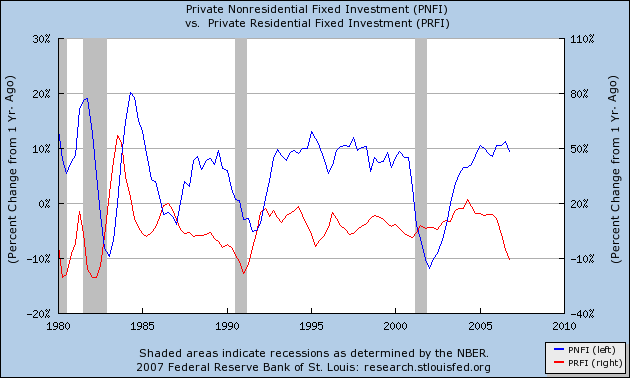
Here's a chart that shows residential versus nonresidential year over year change in investment. Notice that in the early 1980s housing investment led business investment but in the 2001 recession business investment declined without a corresponding residential decline. The 2001 situation was the result of the massive Y2K investment. In other words, it was a unique economic event.
It's important to note January's manufacturing numbers. All of the Federal Reserve districts reported lukewarm results. Chicago's PMI moved into a recessionary level. While 4th quarter industrial production increased .4%, the 4th quarter saw an overall decline. In short, manufacturing numbers were moderate at best.
This means that February's manufacturing surveys are very important, so keep your eye on them.


2 comments:
Simple answer: yes.
The housing downturn as it unrolls looks like it will clearly bring gross investment to neutral at best.
Consumer finance has been on the back of the housing equity boom, aided by the structural shift as a result of the creditor-friendly bankruptcy bill ... but the equity boom is basically over, while the impact those kind of structural changes are one-off shifts, not ongoing growth.
So its down to government spending and exports as possible growth drivers. Government is certainly generating deficits, but much of the deficit spending is overseas where its impact on domestic economic activity is muted.
Which leads to focusing hopes on the possibilities of an export boom. But a shift in the US dollar large enough to fuel an export boom will cause financial disruption abroad and substantial imported inflation here, both of which will tend to push the Fed toward substantial raises in the overnight cash rate.
Note that none of this implies that a recession is certain ... what it means is that good news has to come around the corner before the positive impact of the return of oil prices to their baseline has faded.
In September I would have speculated that MS would not be treating a first-tier Los Angeles private equity firm like Blackstone this way. But as the Fall has progressed and the potential liability increased it is clear that banks are willing to risk even their largest clients to wriggle away from some of these deals.
Post a Comment