Monday, July 23, 2007

When Will the Dollar's Decline Stop?

From the Financial Times:

How long before the dollar hits $1.40 to the euro? That is the question many analysts are asking after a week when the US currency struck a new low of $1.3843 to the euro and fresh multiyear lows against a range of currencies, including sterling.

The US currency has fallen 4.5 per cent against the euro this year and 4 per cent against sterling, hitting a new 26-year nadir against the pound last week. The trade-weighted dollar index dropped to its lowest since 1992.

The dollar exchange rate is important because the US relies on hefty foreign purchases of securities and other assets to fund its current account deficit.

“At some point, the fall in the dollar will translate into foreign investors no longer buying US assets and selling their existing holdings,” said William Strazzullo, chief market strategist at BellCurve Trading.


The last paragraph states a really important question: when will the dollar's value decline to a level that makes investing in US debt securities a bad idea? There is no answer for that. However, consider the following chart from the St. Louis Federal Reserve which shows total foreign holdings of US debt securities. Notice the amount has more than doubled in the last 7 years.
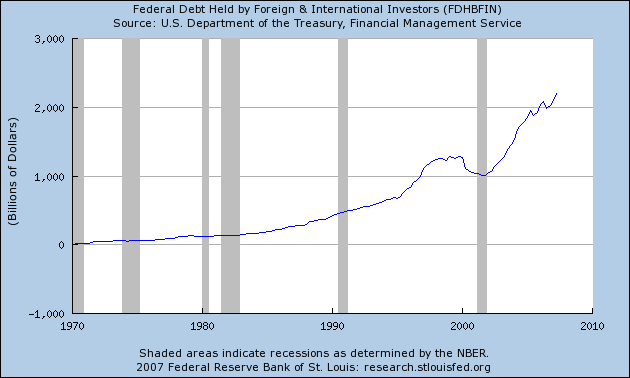
Photo Sharing and Video Hosting at Photobucket

How long will this trend continue when the dollar's chart looks like this?
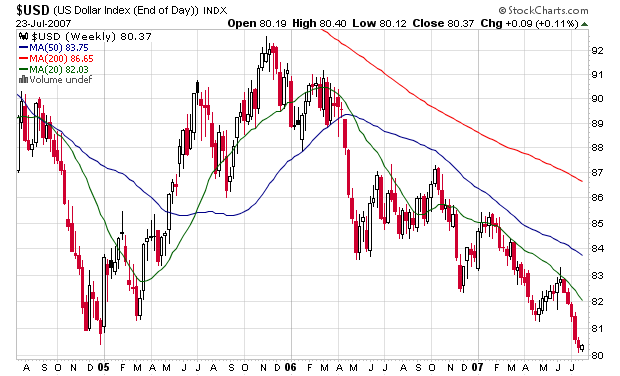
Photo Sharing and Video Hosting at Photobucket

3 comments:

adan lerma said...

there's so much information, it's hard for me to balance it all (though it's sometimes almost fun :-)

so foreigner's "may" buy less debt securities, it seems so to me most the time that'd make sense; but recently i've begun to ask, because of info coming from sites such as yours, is that true for all debt? haven't we seen a divergence, even if slight, toward treasuries, even as there's a growing skitishness from other debt, even other supposedly AAA debt?

then i've read, a snowball of pension asset shifting has begun, and some believe this is the start of an eventual avalanche or rush into, again, treasuries, but, not other, even other as supposedly highly rated, debt

so if i had to hedge my small and meager savings, and i'll admit they're small and only i'm to blame for that, mostly, i'd choose to hedge into both treasuries and gold, and silver - in what proportions? well, liquidity seems to be a rising concern :-)

thank you much for continuing such great info, it's like playing a mental racket ball game between greed, fear, and survival

CA Pol Junkie said...

It seems to me that it's not the level of the dollar that should concern foreign investors, but the direction that level is going. After all, when the dollar is cheap, that means it's a good time to buy. If it's going to get even cheaper, then not so much.

As the graph shows, any foreigner investing in dollars has gotten hammered over the last year and a half as the dollar has declined 6-7% per year. The big question is what level the dollar should be at. As I'm invested in Europe, I'm betting that the dollar will continue its decline for a while. I hope indicators like the trade deficit and interest rates here and abroad will give me an idea about when to shift my investments back toward dollars.

Anonymous said...

the drop will stop when the following happens:

1) the fed quits printing money. m3 is growing at 12 to 13 % per anum. Why would someone hold $'s when the Fed is debasing the currency.

2) Trade deficits fall. There are too many dollars are being circulated abroad chasing too few goods.

3) The Chinese, Koreans, and Japanese stop theire currency manipulatations. Those govt's are not allowing the $ to find a real price so speculators are excarcebating the fall.

To conclude, since neither 1,2 nor 3 will happen. we will find ourselves with a dropping dollar for a long time.