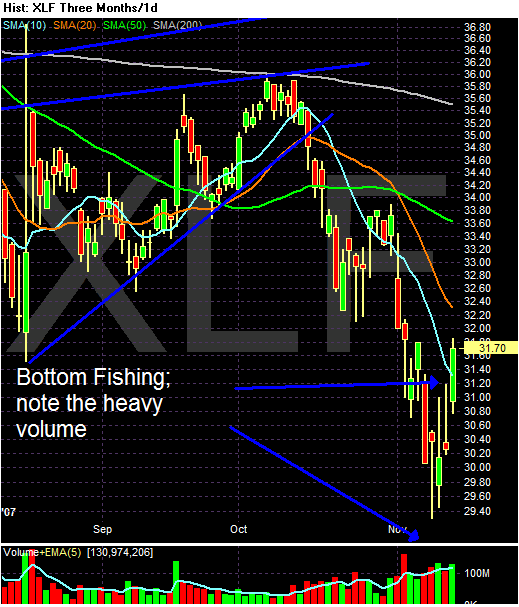
But the fundamentals of this sector are still terrible. We've seen a ton of writedowns over the last few months (if memory serves, the total is nearing $50 billion). So what we're seeing here is bottom fishing. People are looking at the chart and thinking, "gee, that looks really cheap". But there are some serious problems with this.
1.) We don't know if the writedowns are over. And I seriously doubt they are.
2.) Just because something is cheap, doesn't mean its good. And again, right now, financials aren't good investments.
3.) Note the chart's technicals. Prices are still below the 200 day SMA by a wide margin, the SMAs are all moving lower and the shorter SMAs are below the longer SMAs. This is still a bearish chart in a big way.


3 comments:
Of course you are correct.
But do you really think that Bernanke/Paulson et. al. will allow these companies to fall too far?
I've been hearing a whirling sound alot lately .....
Is it possible that there are any good stocks in this sector? A reputable source* of business news recently had a special offer: they sent me free picks of undervalued stocks. Two of them are building materials companies and one is a real-estate financial that recently converted to an REIT for tax advantages.
Even if it' accounts were healthy, I wouldn't touch a building materials company with a 10 foot pole....but the REIT has me intrigued.
The analysis claims:
"The company makes specialized and customized loans."
"In all, XXXX** has $20.1 billion in assets, which includes $6.5 billion in residential mortgage assets. Added to the $ 9billion in real estate loans it makes through its normal lending channels, these residential mortgage assets push XXXX’s total real estate loans above the 75% of total assets necessary for it to qualify for tax-free REIT status."
"The [residential mortgage assets] that XXXX holds — purely for [REIT] compliance reasons — are the cream of the crop. They’re prime and better-than-prime loans with essentially no credit risk. This area of the business was designed to push the company over that 75%
mark in as risk-free a way as possible."
What the hell is a "better than prime loan" ?
As a lender, XXXX is exposed to credit risk, but with charge-offs of less than 1%, the company is on good footing considering it’s taking in 12% on its loans..
Does this sound like BS...or might they be on to something?
If I do invest in it, I won't hold anybody responsible here, if it goes down the gurgler.
*/** Names left out to protect the guilty and respect any anti-shilling guidelines that may be in place
I found the fly in the ointment...
In order to retain its tax-exempt REIT status, XXXX has to pay out 90% of its earnings. Since it can't retain earnings, it's taken on an eye-popping amount of debt: it's debt/equity ratio is over 80%.
So, I'm not going to touch this one with a 10 foot pole, either.
Post a Comment