Wednesday, March 5, 2008

OPEC Squeezing the Last Drops of Profit

From the WSJ:

With oil prices hovering near record highs and inventories flush, OPEC ministers meeting in Vienna today are all but sure to leave output unchanged. But with so much uncertainty facing the market, the group is likely to meet again in the next few months, amid deep-seated concern about the direction the global economy is taking and the implications for oil demand.

The 13-member Organization of Petroleum Exporting Countries, which supplies 40% of the world's crude, faces a tough dilemma. Were it to cut production at a time of high prices, it could get the blame if the world tips into recession. If it raises output as demand weakens, prices could nose-dive, threatening the group's revenue.

The U.S. made a last-ditch appeal to the cartel to raise output. President Bush said it was a "mistake" to have your biggest customers' economies slowing down because of high crude prices, which he warned could cause people "to buy less energy over time." The U.S. Energy Information Agency said OPEC should raise oil-production levels by between 300,000 and 500,000 barrels per day.
Oil rose nearly 20% in less than one month and trading has been volatile after OPEC signaled it would keep output unchanged. Krista Nonnenmacher, an independent market maker with AMEX, discusses the oil market and geo-political influences.

But the group is likely to sit on its hands. "It seems like there will be no change," Iran's oil minister, Gholam Hussein Nozari, said yesterday after a meeting of the committee that recommends policy decisions to OPEC.


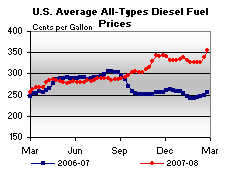
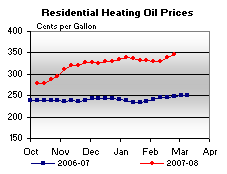
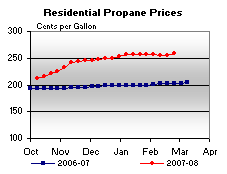
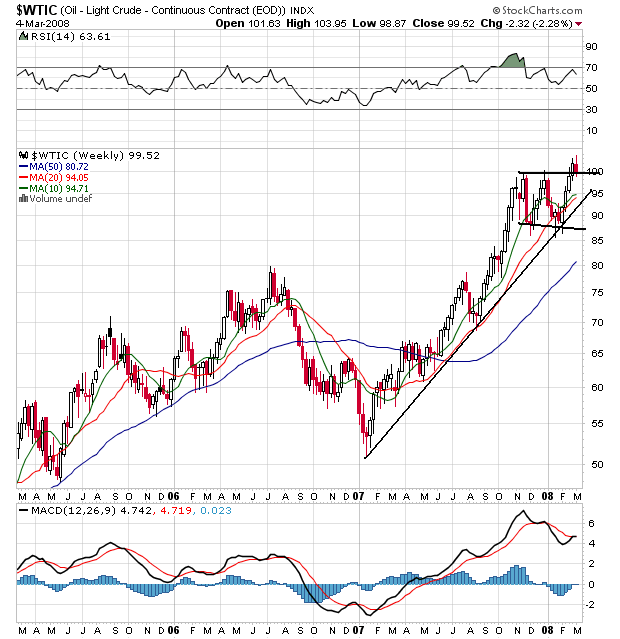
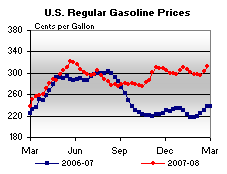
The problem with the US' request is we're no longer OPEC's only big customer. Previously the statement from the US would have had weight. But now 1.3 billion people in China and and 1.1 billion people in India have a higher standard of living. Even if their economies slow there is now more wealth in those countries which increases their demand for oil. As a result, we get price charts like this:


And the US will simply have to get use to prices like this:


5 comments:

Scott said...

This is a problem of geology, not market fundamentals. We have a rapidly disappearing finite source of energy, with various ruling elite's competing for it. Unfortunately, it looks like a last man standing game.

Fade said...

Well, no matter how Bush begs, OPEC has no duty to the U.S. He might as well be begging Exxon Mobil to give up some of their record profits in order to help their country.

Shit, I'd trust Chavez to treat the U.S. consumer better than the Exxon Mobil board...

Anonymous said...

Oil is currently traded in U.S. dollars, yes? The value of the dollar has continually been going down (vs. euros, etc.). I assume oil "owners" are not happy seeing their profits being devalued, accordingly, so they raise oil prices to compensate for the devaluation of the dollar (lowering of their profits). Isn't that what is mainly going on?

pft said...

Whatever happened to gunboat diplomacy?

China is a red herring. They get 40% of their imports from OPEC, and only 10% of OPECs total exports. Most of their consumption by the way is to produce exports for our use.

OPEC exported 31.9 mbd in 2007 and is projected to export 31.5 mbd in 2008 due to lower global demand, while keeping production at 2007 levels. Prices should be dropping, yet we have seen oil increase from 90 to 104 in a matter of weeks (15%)

The oil prices are driven by speculators. NYMEX set up an exchange in Dubai last June, called the Dubai Mercantile Exchange. Since they started trading in oil futures, prices have increased from 65 dollars a barrel to 104 as of today. NYMEX has a sweet deal with DME incidentally.

So now we can finger DME and OPEC, but oil is where it is at because we want it there. Only with high oil prices will alternative oil supplies (oil sands, deep sea wells) be economically viable. Also, high oil prices help slow demand by developing nations. Might be a good time to go long on nuclear.

Also, we only get 50% of our imports from OPEC. And if you think our oil companies pay market price for oil from Saudia Arabia, Nigeria and Iraq, which is 1/2 of our OPEC imports, you would be wrong. The profits get lost in the tax havens, while we pay market price for our refined products.

Anonymous said...

Why then the seemingly inverse relationship between the US dollar and oil prices?