Ministers from the Organization of Petroleum Exporting Countries, meeting in Vienna, blamed surging oil prices on the weak U.S. dollar and "mismanagement" of the U.S. economy. President Bush shot back, telling a renewable-energy conference in Washington that "it should be obvious to all that the demand [for oil] is outstripping supply." The U.S., he said, must change its habits. "We've got to get off oil," he said.
Mr. Bush urged OPEC this week to pump more oil. The cartel supplies just less than 40% of world demand.
OPEC ministers said they see a well-supplied market. OPEC President Chakib Khelil said the oil market is "moving into a new phase" of slower economic growth and ebbing demand.
The oil market is interesting right now. I don't think there s one factor that is pushing prices up, but instead a strong vortex of three events
-- Chine and India and their over 2 billion people have an increased standard of living. That means they want more energy (and food).
-- The dollar is dropping and has been for some time. That means the currency that oil is priced in is dropping which is a de facto increase in the price of oil.
-- There is a flight to the commodities area as an inflation hedge against the dropping dollar. It is also the only market that is rallying right now, so we're getting a number of speculators in the market.
Let's see what the charts say about the oil/dollar price relationship.
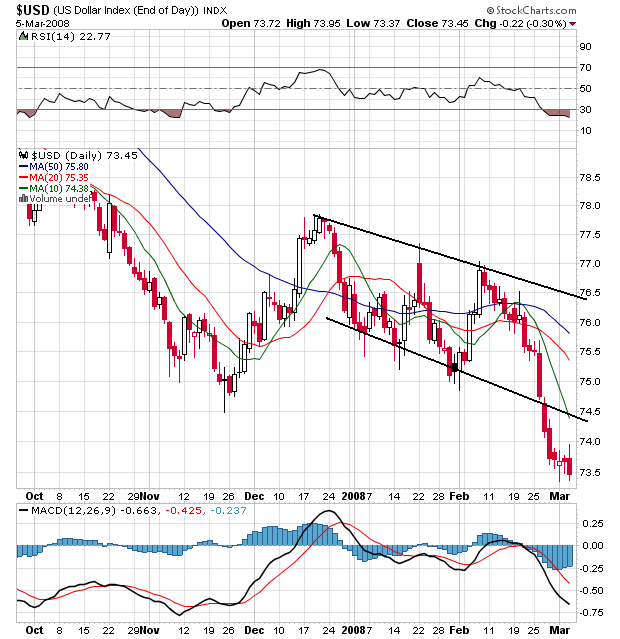
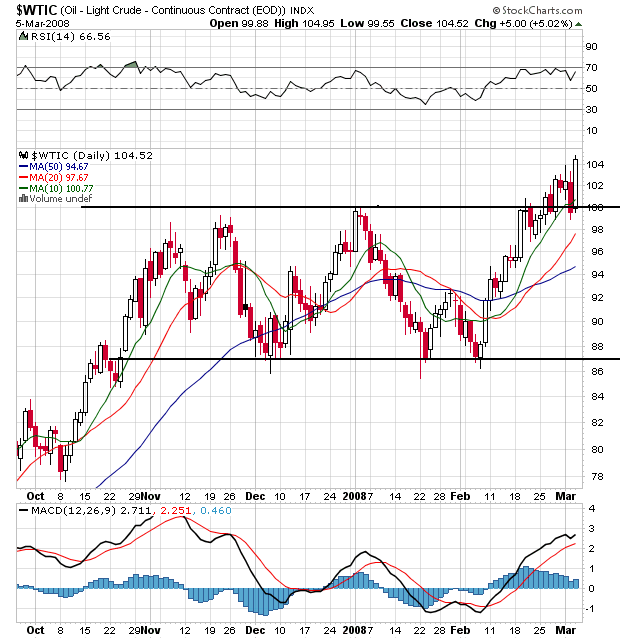
Notice the following:
-- The dollar's chart is "down/bear market rally or consolidation/down
-- Oil's chart is up/consolidation/up.
Those charts look pretty "mirror imagey" to me. It's not an exact match, but it's pretty clear that oil and the dollar are clearly linked.


5 comments:
Let's get real about what's driving the price of oil. It's both demand/supply and the fall in the dollar's value. Bush and his posse don't understand yet that the Saudis can't - repeat, can't - lift any more crude. Nor can any of the other suppliers, except perhaps for Venezuela and Canada. Bush and his cronies can lean on the Saudi princes all they want but it won't produce one more barrel of oil. The Saudis are maxed out and they've played us for fools for the last seven years. Bush has relied on his being able to persuade them to open the oil valves just a little more to dampen price increases while doing nothing to reduce domestic US demand because the Saudis had promised to reduce prices. He's been left standing at the altar by his Saudi friends and the rest of us are going to be left with the job of picking up the tab for the reception which never occurs. The dollar's decline just adds a little more juice to that petroleum price zoom skyward, kinda like an afterburner in one of Bush's old USAF interceptors.
Maybe Bush should consider that his failure to do anything to reduce oil dependency is one part of his economic mismanagement.
The oil supply excuse is being overstated in regard to why oil prices in the U.S. have risen so rapidly.
Yes, China and other "developing" countries are using more oil and other energy sources (such as coal, by the way), but not to the degree that would create the current so-called tight supply situation. In addition, don't forget that China, in particular, acquires oil from many countries other than Saudi Arabia.
By the way, I doubt the Bush Administration is pushing the Saudis to do anything other than continue to purchase U.S. arms. Along that line, don't forget that U.S. oil companies continue to make their highest profits ever.
One point I forgot to mention is that if tight supply were really the main issue, wouldn't it also impact other oil suppliers throughout the world such as Venezuela, Russia, etc.
If global oil supply were in such dire straits, why for example does Venezuela have enough to provide/donate to low income folks in the U.S.
Also keep an eye an recent political developments -- Venezuelan troops on Columbia border (note: Columbia is US proxy in S. America right now) and warships crossing Suez Canal into the Gulf. Is the political driving the economic or vice versa.
charlottemom
Post a Comment