Wednesday, April 9, 2008

Why Transports Matter

From Marketwatch:

United Parcel Service Inc. cut its first-quarter earnings range, surprising analysts, as the delivery giant got chilled by the same bitter economic headwinds affecting everything from airlines and automakers to banks and retailers.

The profit warning appears to be weighing on financial markets in early action on Wednesday, with S&P 500 futures down 6.8 points to 1,364.20 and Nasdaq 100 futures off 5.75 points to 1,849. Dow industrial futures fell 46 points. See Indications.

UPS shares fell 3% to $71.15 in pre-market trades.

After the closing bell on Tuesday, the Atlanta-based package transport firm said it now expects a profit of 86 cents to 87 cents a share, down from a range of 94 cents to 98 cents a share. Analysts polled by FactSet Research previously had targeted earnings, on average, of 93 cents a share.

"The U.S. economy has continued to weaken, causing a reduction in domestic package volume and a shift away from premium products. Significantly increased fuel costs in the quarter also contributed to the lower than expected results," UPS said in a statement.


A good report from a transportation company indicates the economy is doing well. The converse is also true.

Last week I wrote an article titled, "Are Transports Signaling a Rebound? I made the following points:

-- The technicals were improving,

-- There was continued chatter about consolidation in the airline industry.

An astute reader pointed about that airlines represent a small portion of the IYT's and therefore the stories linked to them aren't as important for this particular index. This was a very good observation.

I concluded that the real issue for the transport index would be crossing a long-term support line started in early 2004:


The big issue is a rally above the previous long-term support line. And remember the move through that doesn't have to happen on the first time. So keep your eyes open.


Here's a chart of the IYTs
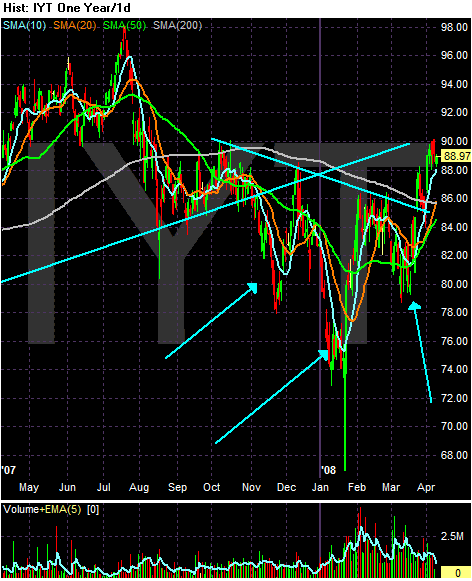


Notice the following:

-- The index rallied from a head and shoulders formation

-- Prices are higher than the 200 day SMA

-- The 10, 20 and 50 day SMAs are all moving higher

-- The 10 and 20 day SMA moved through the 200 day SMA, and the 50 is getting ready to

-- The 10 SMA is higher than the 20 SMA which is higher than the 50 day SMA -- a bullish configuration

-- But, volume has been decreasing as the market is moving higher, indicating a lack of interest on the part of buyers.

Again -- the big issue is getting about the long-term support line. That will be the best tell this market can give us.

5 comments:

Anonymous said...

[I posted this comment in the original IYT thread.]

Our economy currently enjoys a tremendous boom in export-related activity especially in the commodities markets. The U.S. export boom is a relatively new phenomenon, the first occuring during a U.S. economic slowdown in many years. I believe, historically, IYT measured changes in transport activity due primarily to changes in domestic activity.

Question: is there a way to break out transport related demand growth on a domestic versus export basis? Do sector-specific ETFs exist that track stock performance of primarily export related firms?

Unrepentant Liberal said...

Although I find it interesting to look at all your charts in a macro economic kind of way, if technical analysis actually worked, everyone would be one.

Anonymous said...

anonymous,
really good point. I hope it gets address.

BruceMcF said...

No amount of technical analysis can get more information out of the market than is available to some participant in the market.

For the macroeconomic events that depend on information that has not been created yet, a market is as blind as everybody in the market. Which is, of course, why technical analysis is good for spotting trends, not so good for spotting turning points ... while its fascinating to watch a head and shoulders formation and say, "here is where market participants worked out that there was no support to go further up, and so started backing away from the share" ... all it can ever give is the common information being shared by market participants. It can never tell us what surprise is going to be coming around the corner.

On the one hand, everyone wants to know what surprise is coming around the corner, so the fact that technical analysis is not magic is annoying to some ... but on the other hand, its still useful to watch the market participants sort through the information they have on hand.

BruceMcF said...

Question: is there a way to break out transport related demand growth on a domestic versus export basis?

Why would you need to do so? The dollar is dropping, so US firms are in a position to gain market share in markets overseas. The domestic economy is sliding into recession, so few US firms will face capacity constraints in chasing overseas markets.

And there is at least the prospect of this being an unsynchronized recession, as the Indian and Chinese economies have multiple growth drivers in addition to exports to the US, and so as long as Europe avoids contagion, it could end up being confined to mostly North America. If it remains an unsynchronized recession, then a bigger market share in overseas markets translate into a larger volume of sales in US$.

And the income to transport firms that are moving that product plays the same role that transports play in an upturn in domestic activity ... it focuses on changes in economic activity that result in product moving.

Indeed, if we saw good enough news in terms of the dollar really plummeting in value, it could still short-circuit the recession currently in process ... I saw this happen once in Australia while living there in the 90's.

If you wanted to estimate what portion of the transport revenue is coming from exports, the most straightforward estimate would be to get the most recent sectoral breakdown on export earnings, then apply the I/O multipliers for the transport sector to those export earnings. That would estimate how much of the gross revenue stream for transport is coming from exports.