Friday, November 14, 2008
Weekend Weimer and Beagle
I'm writing this from my IPhone. I'll be back on Monday in the early AM. Until then do anything except think about the market or the economy.


Retail Sales: Cliff Diving but a Silver Lining
From Bloomberg:
According to the Census data all areas took a major hit: Autos -5.5%, electronic retailers -2.3%, department stores -1.3%. In other words, the consumer is really cutting back on spending. Here's the relevant graph from the Census information:

Click for a larger image
This shouldn't be a surprise. The stock and real estate markets are in terrible shape and the employment picture is horrible. Put these two things together and you get a consumer led contraction.
As a result, several retail sectors are in terrible technical shape, trading at or near multi-year lows:

Click for a larger image

Click for a larger image

Click for a larger image

Click for a larger image

Click for a larger image
However, there is something good emerging from this. When consumers don't spend on stuff they save. And on that front, banks are helping out:
Banks are starting to attract customers the old fashioned way; they are luring people by paying them a meaningful rate on their deposits. Simply put, banks must return to standard, nuts and bolts banking. They need to increased their deposit base to make loans. And the way to do that is to acquire depositors. So while the retail news is bad in the short run, it looks as though an important and fundamental change may be starting. And that's a good thing.
Retail sales in the U.S. dropped in October by the most on record, pushing the economy toward the worst slump in decades.
The 2.8 percent decrease was the fourth consecutive drop and the biggest since records began in 1992, the Commerce Department said today in Washington. Purchases excluding automobiles also posted their worst performance.
Spending may continue to falter as mounting job losses, plunging stocks and falling home values leave household finances in tatters. Retailers from Best Buy Co. to Nordstrom Inc. are cutting revenue forecasts ahead of what may be the worst holiday shopping season in six years.
``We are in the eye of the storm,'' said James O'Sullivan, a senior economist at UBS Securities LLC in Stamford, Connecticut, who accurately projected the decline in sales. ``The recession is clearly intensifying. The next few months will look pretty bad. The fourth quarter will be even weaker.''
According to the Census data all areas took a major hit: Autos -5.5%, electronic retailers -2.3%, department stores -1.3%. In other words, the consumer is really cutting back on spending. Here's the relevant graph from the Census information:

Click for a larger image
This shouldn't be a surprise. The stock and real estate markets are in terrible shape and the employment picture is horrible. Put these two things together and you get a consumer led contraction.
As a result, several retail sectors are in terrible technical shape, trading at or near multi-year lows:

Click for a larger image

Click for a larger image

Click for a larger image

Click for a larger image

Click for a larger image
However, there is something good emerging from this. When consumers don't spend on stuff they save. And on that front, banks are helping out:
Banks across the U.S. are engaged in a heated competition for deposits as the battered industry tries to shore up its funding sources.
From giant Citigroup Inc. to tiny S&T Bancorp Inc. -- which is based in Indiana, Pa. and has just 55 branches -- banks are responding to uncertain times by sharply increasing the interest rates paid on deposits.
The result is a boon for consumers hungry for higher returns as the stock market lurches. But the moves are causing pain for large and small banks across the U.S. by squeezing their profit margins.
The desire to lure depositors is triggering a "national price war," says Michael Poulos, a partner at financial-services consulting firm Oliver Wyman. "In the past 15 years, there's been nothing like this. The level of competitive intensity is unprecedented right now."
The deposit-collecting binge could help banks build up the funds needed to make new loans. That could help ease the credit crunch choking the economy.
Banks are starting to attract customers the old fashioned way; they are luring people by paying them a meaningful rate on their deposits. Simply put, banks must return to standard, nuts and bolts banking. They need to increased their deposit base to make loans. And the way to do that is to acquire depositors. So while the retail news is bad in the short run, it looks as though an important and fundamental change may be starting. And that's a good thing.
So Much for "Decoupling"
From Marketwatch:
First, recession is defined as two quarters of negative growth according to people who need simplistic talking points to deliver. The reality is usually far more complicated.
Looking deeper into the news report, it's clear there are serious problems. Manufacturing is taking a huge hit, the credit crisis has slammed the service industry and housing/construction is taking a massive hit from a housing contraction. If this looks incredibly familiar, it should: it's exactly what is happening in the US.
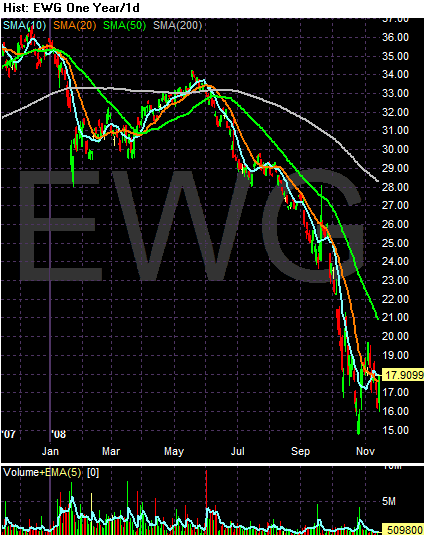
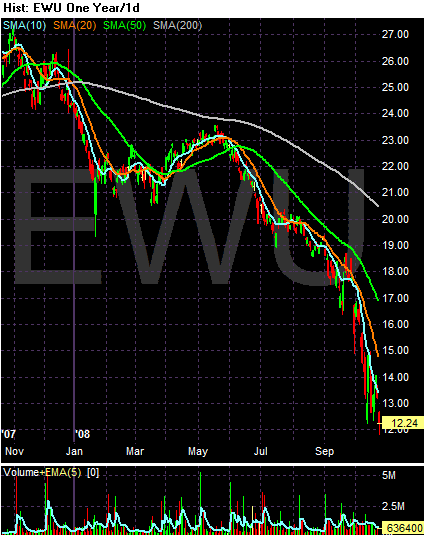
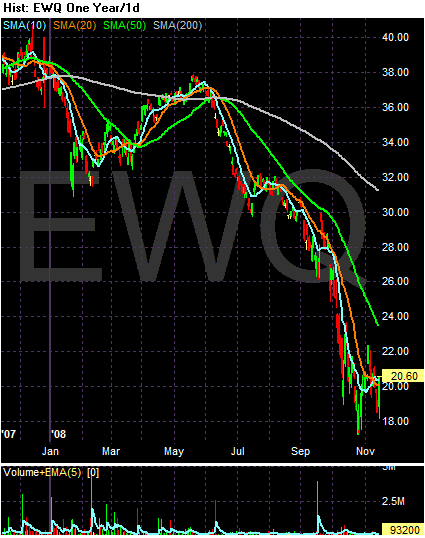
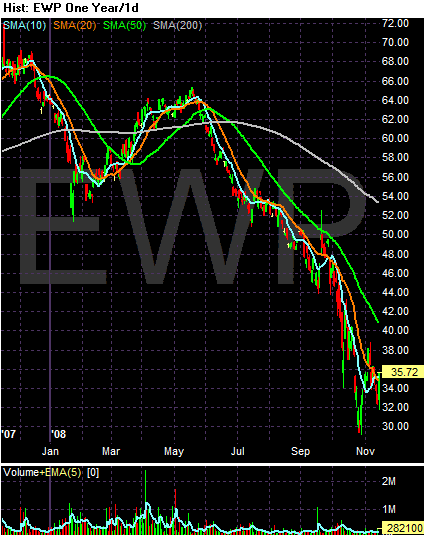
Here are some of the relevant ETFs. All show economies that traders are expecting to be slow or negative growth.
Germany
United Kingdom
France
Spain
And Europe isn't the only economy now is a recession:
Here is the relevant ETF. Like the European ETF's this one shows an economy traders are expecting low or no growth from:
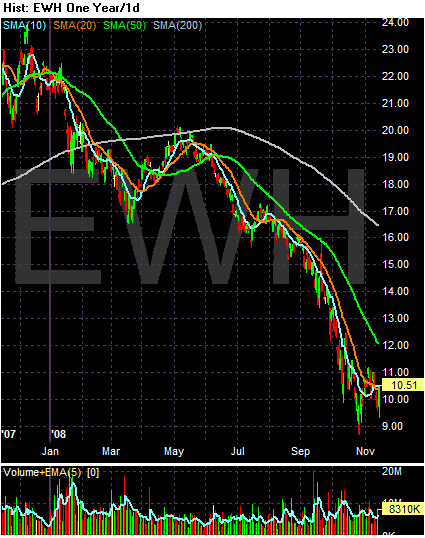
A global economic slowdown, financial turmoil and home-grown problems pushed the 15-nation euro zone into its first recession since the debut of the single currency nearly a decade ago, data showed Friday.
The region's third-quarter gross domestic product shrank 0.2% compared to the previous quarter, according to the statistical agency Eurostat. The second quarter also saw a 0.2% decline.
Recession is commonly defined as two or more consecutive quarters of falling GDP.
On an annualized basis, GDP for the July-through-September period rose 0.7% compared to the same period last year -- the slowest pace of annual growth in more than six years.
And it's going to get worse, economists say.
"With manufacturing activity in a freefall due to an inventory overhang and plunging orders, services hit hard by the credit crisis and construction activity starting to contract, future growth prospects appear gloomy," said Aurelio Maccario, chief euro-zone economist at UniCredit MIB in Milan.
The recession's likely to deepen in the current quarter and into the first quarter of 2009, said Maccario, who has penciled in 0.4% declines for both quarters, as well as a negative outturn in the second quarter before signs of a rebound emerge during the second half.
Also of note, bank lending is likely to slow sharply, said Ben May, an economist at Capital Economics.
And with exports set to drop amid the global economic slowdown and falling house prices likely to erode household wealth, the euro zone is on track to contract by 1% in 2009, he said.
Reinforcing the gloom, European registrations for new passenger cars fell 15% on the year in October, to 1.13 million vehicles, as consumers continued to delay big-ticket purchases, the European Automobile Manufacturers Association, said Friday.
First, recession is defined as two quarters of negative growth according to people who need simplistic talking points to deliver. The reality is usually far more complicated.
Looking deeper into the news report, it's clear there are serious problems. Manufacturing is taking a huge hit, the credit crisis has slammed the service industry and housing/construction is taking a massive hit from a housing contraction. If this looks incredibly familiar, it should: it's exactly what is happening in the US.
Here are some of the relevant ETFs. All show economies that traders are expecting to be slow or negative growth.
Germany
United Kingdom
France
Spain
And Europe isn't the only economy now is a recession:
Hong Kong's economy moved into recession for the first time in five years in the third quarter, as the financial crisis ripped through its property and stocks markets, and slowing global business conditions damped demand for service-sector dependant economy.
Gross domestic product contracted 0.5% from the previous quarter, after contracting 1.4% in the second quarter, according to government data released Friday.
"Demand towards the end of the quarter was severely hit by the outbreak of the global financial tsunami that caused significant jitters in the local asset markets," the government said in the release
Here is the relevant ETF. Like the European ETF's this one shows an economy traders are expecting low or no growth from:
Forex Friday

Click for a larger image
Notice the following on the weekly chart:
-- Prices have advanced almost 20% a month and a half
-- All the SMAs are moving higher
-- The shorter SMAs are above the longer SMAs
-- Prices are above the longer SMAs
BUT
-- The RSI is overbought, and
-- The MACD is overbought

Click for a larger image
Notice the following on the daily chart:
-- Prices have continually moved through resistance
-- Prices are above all the SMAs
-- All the SMAs are moving higher
-- The shorter SMAs are above the longer SMAs
BUT
-- The MACD is declining, and
-- The RSI is weakening
Bottom line: this is a chart that wants to correct a bit.
Thursday, November 13, 2008
Today's Markets
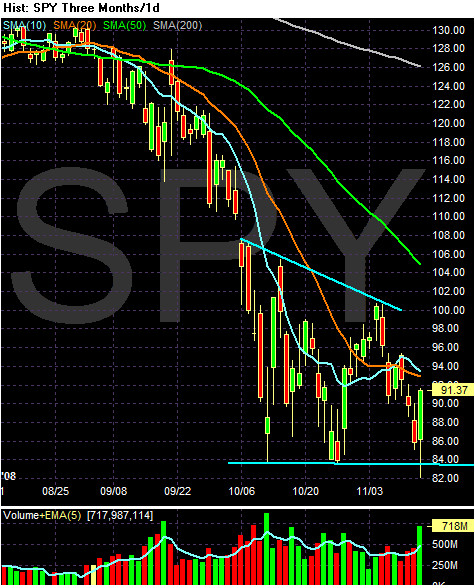
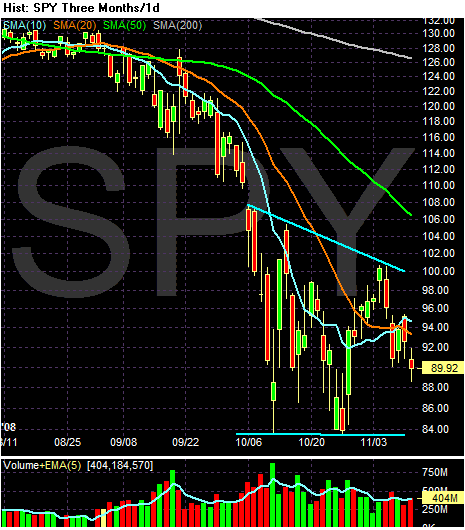
Why is Bonddad smiling? Because the market is still consolidating. Also -- note the market tested the 84 level to and rallied from that level on strong volume. That's a very good technical sign.
So -- the market is still in the middle of a triangle consolidation.
Employment Looking Worse...But It's Actually A Good Thing
From Bloomberg:
This means unemployment won't be getting better anytime soon.
However in a perverse way this is actually good news. Before you throw the heavy object in your hand at the screen let me explain that last comment.
I think the recession started in the 1Q of 2008, although I have seen other argue it was the 4Q of 2007. Either way we've been in it for at least 10 months and maybe more. But we're clearly not out of the recession yet. In fact, it appears the problems are accelerating. That means this won't be a short recession like the 2001 recession which lasted 9 months. Instead, this slowdown will last at least 18 months and probably more.
Now looking at the last expansion we see a terrible record of job creation. The best reading of total jobs created is 7.2 million. I think some of the reason for this slow rate of job growth is companies have become more and more reluctant to hire new people, instead preferring to increase productivity to the nth degree. As a result, now when a company does hire somebody it's a big and important investment. On the flip side of that observation, it also means that companies are more reluctant to let people off because each new employee is now more important; they're a bigger piece of the company's overall productivity picture.
Also remember that employment is a lagging economic indicator. It is one of the last indicators to start increasing during an expansion and one of the last to start dropping in a recession.
So - when we see an increase in job losses last months it means several things.
1.) The second phase of the contraction is beginning. That means we're closer to the end.
2.) We've already lost 1.2 million jobs this year, or 16% of all the jobs created in the last expansion. Job losses accelerated in the last three months, totaling 651,000. That means we lost 9% of all jobs created during this expansion in the last three months. While there is no upward limit on what can be lost, I seriously doubt we'll loose the entire 7.2 million.
What all of this means is I think there is only so far we can go in terms of job losses. Let's assume a really bad scenario and assume that we'll lose 40% of the jobs created or 2.8 million. Because we've already lost 1.2 million we've got 1.6 million to go. Assuming a 250,000/month pace that means we've got about 6-7 months left of serious job losses.
I should add (and I should do this more often) I could be seriously wrong in my thinking here.
First-time claims for U.S. unemployment insurance rose last week to the highest level since September 2001, when the economy was last in a recession, as weakening demand led companies to fire more workers.
Initial jobless claims increased by 32,000 to a larger- than-forecast 516,000 in the week ended Nov. 8, from a revised 484,000 the prior week, the Labor Department said today in Washington. The total number of people on benefit rolls jumped to the highest level since 1983.
Restrictive credit and slumping demand are causing companies to retrench by trimming payrolls and investment. Rising joblessness will further squeeze consumer spending, which accounts for more than two-thirds of the economy, and threaten a protracted downturn, economists said.
``The labor market is only reinforcing a very pessimistic picture,'' Linda Barrington, a labor economist at the Conference Board, said in a Bloomberg Television interview. ``When you start to see the downward pressure on wages as well as the credit crunch, that's only going to make consumers much more nervous.''
This means unemployment won't be getting better anytime soon.
However in a perverse way this is actually good news. Before you throw the heavy object in your hand at the screen let me explain that last comment.
I think the recession started in the 1Q of 2008, although I have seen other argue it was the 4Q of 2007. Either way we've been in it for at least 10 months and maybe more. But we're clearly not out of the recession yet. In fact, it appears the problems are accelerating. That means this won't be a short recession like the 2001 recession which lasted 9 months. Instead, this slowdown will last at least 18 months and probably more.
Now looking at the last expansion we see a terrible record of job creation. The best reading of total jobs created is 7.2 million. I think some of the reason for this slow rate of job growth is companies have become more and more reluctant to hire new people, instead preferring to increase productivity to the nth degree. As a result, now when a company does hire somebody it's a big and important investment. On the flip side of that observation, it also means that companies are more reluctant to let people off because each new employee is now more important; they're a bigger piece of the company's overall productivity picture.
Also remember that employment is a lagging economic indicator. It is one of the last indicators to start increasing during an expansion and one of the last to start dropping in a recession.
So - when we see an increase in job losses last months it means several things.
1.) The second phase of the contraction is beginning. That means we're closer to the end.
2.) We've already lost 1.2 million jobs this year, or 16% of all the jobs created in the last expansion. Job losses accelerated in the last three months, totaling 651,000. That means we lost 9% of all jobs created during this expansion in the last three months. While there is no upward limit on what can be lost, I seriously doubt we'll loose the entire 7.2 million.
What all of this means is I think there is only so far we can go in terms of job losses. Let's assume a really bad scenario and assume that we'll lose 40% of the jobs created or 2.8 million. Because we've already lost 1.2 million we've got 1.6 million to go. Assuming a 250,000/month pace that means we've got about 6-7 months left of serious job losses.
I should add (and I should do this more often) I could be seriously wrong in my thinking here.
Volatility Explained

Click for a larger image
Wondering why the preceding chart is spiking?
The global hedge fund industry lost $100 billion of assets in October, according to an estimate from Eurekahedge Pte, as firms including Sparx Group Co. and Man Group Plc were hammered by investor redemptions.
Funds fell an average 3.3 percent, based on preliminary figures from the Singapore-based data provider, as measured by the Eurekahedge Hedge Fund Index, which tracks the performance of more than 2,000 funds that invest globally. That compares with a 19 percent slide in the MSCI World Index last month.
The biggest market losses since the Great Depression and investor withdrawals hurt the $1.7 trillion hedge funds industry that manages largely unregulated pools of capital. The index of global funds has lost 11 percent this year, set for the worst performance since 2000 when Eurekahedge began tracking the data.
``This wave of redemptions in the hedge fund industry is going to last for at least another six months,'' said Toyomi Kusano, president of Kusano Global Frontier, a hedge fund research firm in Tokyo. ``There are some funds that halted withdrawals, but those funds would eventually have to defreeze, and that means another wave of redemptions.''
Using the figures supplied in the story, hedge funds lost 5.88% of their total funds. That could lead to some problems. It also explains the wilder gyrations in the market over the last few months. Funds are dumping positions to raise cash to pay withdrawals.
Intel Slashes Outlook
From the AP:
Intel is a key company because it supplies a key component to a lot of different products. So when Intel is hurt everybody is hurt. In addition, technology was considered a safe haven for awhile because it wasn't exposed to the financial market issues. So much for that theory.
Let's place this story in perspective. US GDP was $14.4 trillion in 3Q 2008. Equipment and software investment accounted for $1.013 trillion of that or 7.18%. However, this part of GDP growth hasn't been a major contributor for a bit. Here is a chart of the percentage change from the preceding period for equipment and software investment.

Click for a larger image
So -- what does this mean? Simple: the economy is in serious trouble.
Intel Corp.'s deep cuts to its fourth-quarter guidance offers further evidence that technology companies are in for a beating because of the economy.
The Santa Clara-based company slashed more than $1 billion from its sales forecast and dialed its profit expectations way back. Intel, the world's biggest maker of PC microprocessors with 80 percent of the global market, blamed a clampdown on spending for reducing demand for its chips.
.....
Cisco Systems Inc., the world's largest maker of computer networking gear, reported that orders fell off abruptly in October. The grim forecast suggested that other tech companies will have to absorb major damage to their sales as well. Cisco was the first major technology company to report results that included October.
More specific warning signs for the PC sector emerged last week when Lenovo Group Ltd., the world's fourth-largest PC maker, reported that profits plunged 78 percent.
.....
Intel blamed "significantly weaker than expected demand in all geographies and market segments" and PC makers buying fewer new chips as they burn through existing inventory to save money.
Intel is a key company because it supplies a key component to a lot of different products. So when Intel is hurt everybody is hurt. In addition, technology was considered a safe haven for awhile because it wasn't exposed to the financial market issues. So much for that theory.
Let's place this story in perspective. US GDP was $14.4 trillion in 3Q 2008. Equipment and software investment accounted for $1.013 trillion of that or 7.18%. However, this part of GDP growth hasn't been a major contributor for a bit. Here is a chart of the percentage change from the preceding period for equipment and software investment.

Click for a larger image
So -- what does this mean? Simple: the economy is in serious trouble.
Thursday Oil Market Round-Up

Click for a larger image
Notice the following on the weekly chart:
-- Prices are approaching a three year low
-- All the SMAs are moving lower
-- The shorter SMAs are below the longer SMAs
-- Prices are below all the SMAs
BUT
-- The RSI is oversold, and
-- The MACD is approaching an oversold reading

Click on the image for a larger picture
Notice the following on the daily chart:
-- Prices have been dropping for the last four and a half months
-- All the SMAs are moving lower
-- The shorter SMAs are below the longer SMAs
-- Prices are below all the SMAs
BUT
-- The MACD s rising, and
-- The RSI is giving an oversold reading
Bottom line: I would expect this market to rally over the next few weeks. But, this would be a bear market rally.
Wednesday, November 12, 2008
Today's Markets
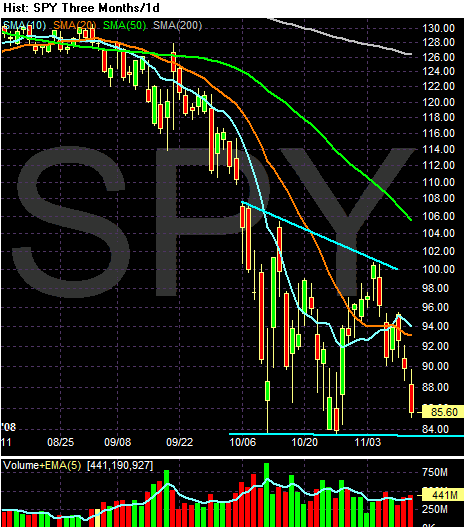
The market is still within the consolidation range that started mid-September. However, we are 1.4% above 84 which is an incredibly key level of support. Given the heavy downward action we've seen lately I wouldn't be surprised to see a test sometime tomorrow or Friday.
Christmas Shopping Season Looking Terrible
From Marketwatch:
Shares of Best Buy fell nearly 12% in premarket trading to $21.08. Since Sept. 12, the stock has tumbled more than 46%.
"Since mid-September, rapid, seismic changes in consumer behavior have created the most difficult climate we've ever seen," said Brad Anderson, the company's vice chairman and chief executive officer. "Best Buy simply can't adjust fast enough to maintain our earnings momentum for this year."
We're Nowhere Near A Bottom In Housing
From Bloomberg:
Remember the basic problems in the housing market:

Click for a larger image
Supply is high from an absolute perspective, and

Click for a larger image
From a months of supply at the current sales pace perspective.
Lending standards are tightening:
As a result, prices are dropping:

Click for a larger image
With employment losses accelerating and the stock market in turmoil I don't think this will change anytime soon.
One-third of U.S. homeowners who sold their property in the 12 months through September lost money as foreclosures depressed prices and more Americans became unemployed in a weakening economy, Zillow.com reported.
Home values fell 9.7 percent in the third quarter, the seventh consecutive decline, to a median $202,966, Seattle-based Zillow, a seller of real estate data, said in a report today. One in seven homeowners had negative equity, or owed more on their mortgages than their houses were worth.
``It's clear we are at a unique point in history,'' Stan Humphries, Zillow's vice president of data and analytics, said in a statement. ``We've had seven consecutive quarters of decline, and we expect that to continue until at least the middle of next year. Most markets are still seeing five-year annualized returns, but we will see more markets slip into flat or negative long-term change as the economy continues to suffer.''
Remember the basic problems in the housing market:

Click for a larger image
Supply is high from an absolute perspective, and

Click for a larger image
From a months of supply at the current sales pace perspective.
Lending standards are tightening:
In the current survey, large net fractions of domestic institutions reported having continued to tighten their lending standards and terms on all major loan categories over the previous three months. The net percentages of respondents that reported tightening standards increased relative to the July survey for both C&I and commercial real estate loans, as did the fractions reporting tightening for all price and nonprice terms on C&I loans. Considerable net fractions of foreign institutions also tightened credit standards and terms on loans to businesses over the past three months. Large fractions of domestic banks reported tightening standards on loans to households over the same period. Demand for loans from both businesses and households at domestic institutions continued to weaken, on net, over the past three months.
As a result, prices are dropping:

Click for a larger image
With employment losses accelerating and the stock market in turmoil I don't think this will change anytime soon.
Treasuries And Supply
From Bloomberg:
My central thesis with the Treasury market going forward is we're either going to move sideways or lower. Here's a 1-year chart of the IEF (7-10 year Treasury market) in weekly increments.
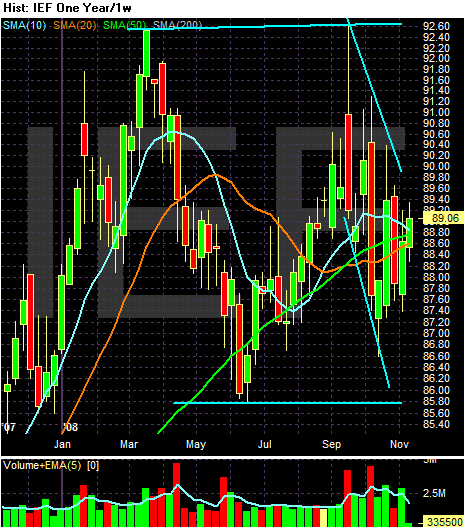
Notice the possible formation of a double top with the first top occurring in March and the second top occurring in September (although that top was an intra-week spike). Either way it makes sense for traders to look at this as a double top and trade accordingly.
There are three reasons for the market to move lower.
1.) Inflation: that's contained now.
2.) Increasing rates. That's not going to happen.
3.) Increased supply. We have a big winner with this one. This is what would lead to the increased rates mentioned above.
What's important to remember here is traders are looking at the increased supply as a net negative for the market. This may become constraining from a fiscal perspective at some time. Remember -- the US is already in debt $10.5 trillion dollars.
Participants turned bearish on 10-year Treasury notes this month for the first time since March, while remaining bullish on government debt from Brazil, France, Germany, Italy, Japan, Mexico, Spain, Switzerland and the U.K., according to the Bloomberg Professional Global Confidence Index. The poll questioned 3,550 Bloomberg users last week.
``The No. 1 reason is supply,'' said Jason Brady, a survey participant and managing director at Santa Fe, New Mexico-based Thornburg Investment Management, which oversees $4 billion in fixed income assets. ``You have Fed and Treasury actions which are supporting credit markets and causing a huge amount of issuance.''
.....
Last week the Treasury Department estimated that it will need to borrow $550 billion this quarter, more than triple an earlier forecast. New York-based Goldman Sachs Group Inc. said Oct. 29 the government's requirement this fiscal year that started Oct. 1 will almost double to $2 trillion.
The federal budget deficit may climb 58 percent to $687.5 billion for fiscal 2009 as U.S. debt swells and the slowing economy crimps tax receipts, according to a survey by the Securities Industry and Financial Markets Association of its members released Oct. 31.
Expectations that yields on 10-year U.S. notes will rise increased to 54.08 in November after reaching a seven-month low of 48.91 in October, according to the Bloomberg survey. The measure is a diffusion index, meaning a reading above 50 indicates that participants expect bonds to weaken and yields to go up.
My central thesis with the Treasury market going forward is we're either going to move sideways or lower. Here's a 1-year chart of the IEF (7-10 year Treasury market) in weekly increments.
Notice the possible formation of a double top with the first top occurring in March and the second top occurring in September (although that top was an intra-week spike). Either way it makes sense for traders to look at this as a double top and trade accordingly.
There are three reasons for the market to move lower.
1.) Inflation: that's contained now.
2.) Increasing rates. That's not going to happen.
3.) Increased supply. We have a big winner with this one. This is what would lead to the increased rates mentioned above.
What's important to remember here is traders are looking at the increased supply as a net negative for the market. This may become constraining from a fiscal perspective at some time. Remember -- the US is already in debt $10.5 trillion dollars.
Even Though Commodities Are Dropping...
From Bloomberg:
Bottom line: We're in a bull market sell-off right now.
The world must find an extra 64 million barrels a day of oil production by 2030, equivalent to replacing Kuwait's output every year, to meet demand growth and counter the decline of existing fields, the International Energy Agency said.
The agency, an adviser to 28 nations, forecasts global oil demand will rise by 1 percent a year through 2030, while the output decline at existing fields will accelerate to 8.6 percent from 6.7 percent. There must be ``adequate and timely'' investment in global oil output for supplies to suffice, the Paris-based IEA said in its annual World Energy Outlook published today.
``There remains a real risk that under-investment will cause an oil-supply crunch'' by 2015 as the decline in output from mature oilfields speeds up, the Paris-based adviser said. ``The gap now evident between what is currently being built and what will be needed to keep pace with demand is set to widen sharply after 2010.''
An additional 64 million barrels a day of additional production must be bought on stream between 2007 and 2030, the group said. That is about 2.78 million barrels a day every year. Kuwait currently produces about 2.6 million barrels a day, according to Bloomberg estimates.
Bottom line: We're in a bull market sell-off right now.
Wednesday Commodities Round-Up

Click for a larger image
On the weekly chart, notice the following:
-- Prices have moved through the lowest technical point on the chart of the last three years
-- All the SMAs are moving lower
-- The 10 and 20 week SMAs moved through the 50 week SMA
-- Prices are below all the SMAa
BUT
-- The RSI is showing an oversold reading, and
-- The MACD is approaching oversold
In addition, the market has sold off a ton

Click for a larger image
Notice the following on the daily chart:
-- Prices have been dropping for three months
-- All the SMAs are moving lowerr
-- The shorter SMAs are below the longer SMAs
-- Prices are below all the SMAs
BUT
-- The MACD is rising, and
-- The RSI's readings are elevated
Bottom line: this chart looks like it wants to engage in a bear market rally.
Tuesday, November 11, 2008
Stimulus, Debt and US Debt Ratings
From Paul Krugman:
From CNBC:
This is only one man's opinion so it's obviously open to debate.
Let's look at this from a debt/GDP perspective. Right now total US debt is about $10.5 trillion while total GDP is about $14.4 trillion (or so). That makes debt/GDP roughly 72%. With the economy contracting the $14.4 trillion will remain the same. So let's increase total US debt to $11.5 trillion. That brings debt/GDP to roughly 80%. While I don't think that means loss of the AAA rating, I do think it puts upward pressure on rates making all that debt far more uncomfortable for policy makers.
So we need a fiscal stimulus big enough to close a 7% output gap. Remember, if the stimulus is too big, it does much less harm than if it’s too small. What’s the multiplier? Better, we hope, than on the early-2008 package. But you’d be hard pressed to argue for an overall multiplier as high as 2.
When I put all this together, I conclude that the stimulus package should be at least 4% of GDP, or $600 billion.
From CNBC:
The United States may be on course to lose its 'AAA' rating due to the large amount of debt it has accumulated, according to Martin Hennecke, senior manager of private clients at Tyche.
"The U.S. might really have to look at a default on the bankruptcy reorganization of the present financial system" and the bankruptcy of the government is not out of the realm of possibility, Hennecke said.
This is only one man's opinion so it's obviously open to debate.
Let's look at this from a debt/GDP perspective. Right now total US debt is about $10.5 trillion while total GDP is about $14.4 trillion (or so). That makes debt/GDP roughly 72%. With the economy contracting the $14.4 trillion will remain the same. So let's increase total US debt to $11.5 trillion. That brings debt/GDP to roughly 80%. While I don't think that means loss of the AAA rating, I do think it puts upward pressure on rates making all that debt far more uncomfortable for policy makers.
Banks Reworking Mortgages
From the NY Times:
All total, these plans could help up to 1 million homeowners. That's a good start.
My guess as to why this is happening is that working out the mortgages is now cheaper than selling the home at a loss in a foreclosure.
Citigroup on Monday joined a growing list of financial institutions offering to modify the terms of mortgages for distressed borrowers, unveiling a program to help thousands meet their monthly payments while reducing the bank’s potential for larger losses as the economy erodes.
About 130,000 mortgage customers are expected to qualify for the program, resulting in the workouts of over $20 billion of loans. Bank executives said they believed it would reduce losses by hundreds of millions of dollars, and possibly more. Like some of its competitors, Citi will also hold off foreclosing on troubled borrowers who have income enough to make their monthly payment and who make a good-faith effort to work out their loan with the bank.
.....
JPMorgan Chase, which acquired Washington Mutual and its troubled loan portfolio, announced plans in late October to cut monthly payments by lowering interest rates and temporarily reducing loan balances for as many as 400,000 homeowners. Bank of America, which acquired the large mortgage lender Countrywide Financial, announced a similar program aimed at 400,000 borrowers as part of a settlement with state officials a few weeks earlier. And HSBC ramped up its mortgage modification effort in January, and has adjusted 61,000 mortgages so far this year.
The loan modification programs closely resemble one that the Federal Deposit Insurance Corporation put in place at IndyMac after it took over that bank in mid-July. Citi plans to reduce monthly payments by temporarily reducing loan balances and by cutting interest rates to as low as 1 percent for up to 2 years. The F.D.I.C. has said it may be able to help 47,000 delinquent IndyMac borrowers.
All total, these plans could help up to 1 million homeowners. That's a good start.
My guess as to why this is happening is that working out the mortgages is now cheaper than selling the home at a loss in a foreclosure.
About the Christmas Shopping Season....

Plus

Plus
Plus

Equals this
"October will prove to be a disaster for retail sales, with only the discounters having anything to cheer about," wrote Avery Shenfeld, an economist for CIBC World Markets. "Note that the ex-autos number will partly reflect the drop in nominal gas-station sales on falling pump prices, and will therefore exaggerate the decline in real terms."
Treasury Tuesdays
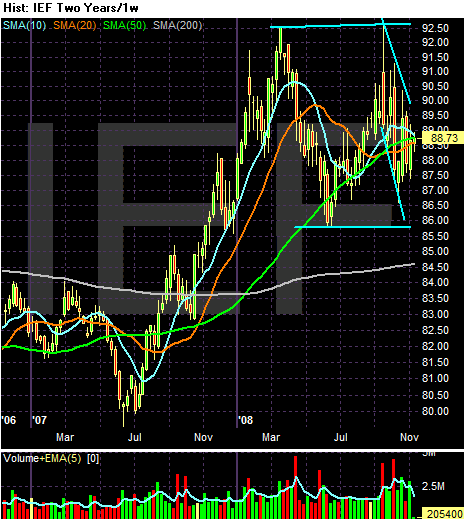
The 2 year chart in weekly increments gives us a great overview of where the market is now. In July of 2007 the beginnings of the financial meltdown started a 9 month rally. That ended in March of this year. Since then the market has been trading sideways, roughly between 86 and 92.5.
A trader could argue the market formed a double top -- which it clearly has. However, what would lead the market to drop from here? The CRB index tells us we're nowhere near inflationary pressures anymore. And there is no sign the Federal Reserve is anywhere near a rate increase. There is concern about supply. With the government deficit increasing to mammoth proportions the Treasury will be issuing a ton of new debt. However, is it enough to send prices through the 86 level?
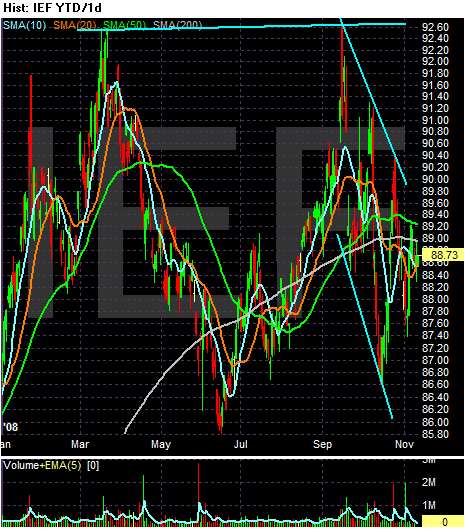
The yearly chart gives us a better view of the sideways trading range the market is going through right now. Most importantly, notice prices and the SMAs are (again) bunched up, indicating a lack of firm conviction for any direction right now.
Monday, November 10, 2008
Today's Markets
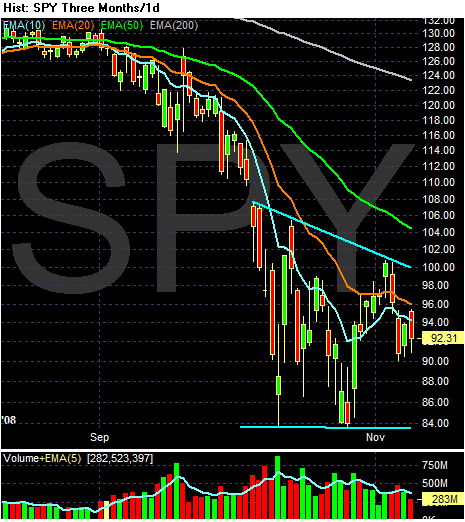
Remember: my central thesis right now is the market is consolidating in a triangle formation at the end of a long sell-off. Today's action keeps us squarely within that triangle. In other words, we're still consolidating.
Regarding the New Fiscal Policy
Former labor secretary Robert Reich lays out the underlying reason for an increase in government spending:
For anyone who has either taken an economics course or looked at the BEA's GDP tables this should be nothing surprising. However, let's take a look at some graphs of how each of these particular parts of GDP have performed.

Click for a Larger Image
As Reich correctly points out, personal spending took a nose dive last quarter. Frankly, no one can blame consumers for not wanting to spend. The stock market was dropping off a cliff and the housing market had been in terrible shape for almost two years. Job losses were increasing as well. This is not the environment when people increase their spending. Considering PCEs account for 70% of US economic growth, this is a big problem.

Click for a larger image
Gross investment has been sagging for awhile as a result of the housing contraction. This number shouldn't change for some time.
The US is running a trade deficit, making exports a moot case. In addition, the rest of the world is also slowing down making our exports less attractive. That leaves government spending:

As the chart above shows, government spending has been increasing over the last three quarters. Given the bail-out numbers we're hearing I would expect this number to increase.
Continuing on this thought we have Paul Krugman from today's NY Times:
I'm not saying in any terms that we should start a World War to get out of the hole we're in. However, note that China has authorized a massive increase in spending over the next few years. Granted -- they have a huge surplus to work from while we have a deficit. However, it's food for thought that they are spending massively.
The real problem is on the demand side of the economy.
Consumers won't or can't borrow because they're at the end of their ropes. Their incomes are dropping (one of the most sobering statistics in Friday's jobs report was the continued erosion of real median earnings), they're deeply in debt, and they're afraid of losing their jobs.
Introductory economic courses explain that aggregate demand is made up of four things, expressed as C+I+G+exports. C is consumers. Consumers are cutting back on everything other than necessities. Because their spending accounts for 70 percent of the nation's economic activity and is the flywheel for the rest of the economy, the precipitous drop in consumer spending is causing the rest of the economy to shut down.
I is investment. Absent consumer spending, businesses are not going to invest.
Exports won't help much because the of the rest of the world is sliding into deep recession, too. (And as foreigners -- as well as Americans -- put their savings in dollars for safe keeping, the value of the dollar will likely continue to rise relative to other currencies. That, in turn, makes everything we might sell to the rest of the world more expensive.)
That leaves G, which, of course, is government. Government is the spender of last resort. Government spending lifted America out of the Great Depression. It may be the only instrument we have for lifting America out of the Mini Depression. Even Fed Chair Ben Bernanke is now calling for a sizable government stimulus. He knows that monetary policy won't work if there's inadequate demand.
For anyone who has either taken an economics course or looked at the BEA's GDP tables this should be nothing surprising. However, let's take a look at some graphs of how each of these particular parts of GDP have performed.

Click for a Larger Image
As Reich correctly points out, personal spending took a nose dive last quarter. Frankly, no one can blame consumers for not wanting to spend. The stock market was dropping off a cliff and the housing market had been in terrible shape for almost two years. Job losses were increasing as well. This is not the environment when people increase their spending. Considering PCEs account for 70% of US economic growth, this is a big problem.

Click for a larger image
Gross investment has been sagging for awhile as a result of the housing contraction. This number shouldn't change for some time.
The US is running a trade deficit, making exports a moot case. In addition, the rest of the world is also slowing down making our exports less attractive. That leaves government spending:

As the chart above shows, government spending has been increasing over the last three quarters. Given the bail-out numbers we're hearing I would expect this number to increase.
Continuing on this thought we have Paul Krugman from today's NY Times:
That said, F.D.R. did not, in fact, manage to engineer a full economic recovery during his first two terms. This failure is often cited as evidence against Keynesian economics, which says that increased public spending can get a stalled economy moving. But the definitive study of fiscal policy in the ’30s, by the M.I.T. economist E. Cary Brown, reached a very different conclusion: fiscal stimulus was unsuccessful “not because it does not work, but because it was not tried.”
This may seem hard to believe. The New Deal famously placed millions of Americans on the public payroll via the Works Progress Administration and the Civilian Conservation Corps. To this day we drive on W.P.A.-built roads and send our children to W.P.A.-built schools. Didn’t all these public works amount to a major fiscal stimulus?
Well, it wasn’t as major as you might think. The effects of federal public works spending were largely offset by other factors, notably a large tax increase, enacted by Herbert Hoover, whose full effects weren’t felt until his successor took office. Also, expansionary policy at the federal level was undercut by spending cuts and tax increases at the state and local level.
And F.D.R. wasn’t just reluctant to pursue an all-out fiscal expansion — he was eager to return to conservative budget principles. That eagerness almost destroyed his legacy. After winning a smashing election victory in 1936, the Roosevelt administration cut spending and raised taxes, precipitating an economic relapse that drove the unemployment rate back into double digits and led to a major defeat in the 1938 midterm elections.
What saved the economy, and the New Deal, was the enormous public works project known as World War II, which finally provided a fiscal stimulus adequate to the economy’s needs.
I'm not saying in any terms that we should start a World War to get out of the hole we're in. However, note that China has authorized a massive increase in spending over the next few years. Granted -- they have a huge surplus to work from while we have a deficit. However, it's food for thought that they are spending massively.
Taiwan and South Korea Cut Rates
From the WSJ:
Note the speed at which these central banks are cutting rates -- 4 time in 8 weeks and 3 in 4 weeks.
These are panic cuts, plain and simple. Something has changed in a big way.
Taiwan's central bank on Sunday cut its key interest rate for the fourth time in less than eight weeks after the island posted its biggest decline in exports in nearly four years. The move in Taiwan came two days after South Korea reduced its main interest rate. Both cut rates by a quarter of a percentage point.
.....
The interest-rate reduction that the Bank of Korea announced on Friday was its third in four weeks, as Seoul tries to fight off an abrupt slowing of the country's economy.
Note the speed at which these central banks are cutting rates -- 4 time in 8 weeks and 3 in 4 weeks.
These are panic cuts, plain and simple. Something has changed in a big way.
The Detroit Death March Continues
From the WSJ's Washington Wire:
Let's look at some of these statements:
Actually, downright stupidity was the primary reason for their current problems. While every other car company on earth recognized that smaller, more fuel efficient cars were the future Detroit stayed with their "everyone loves a truck" theme. As a result, when gas skyrocketed to nearly $4 gallon (and higher in some places) Detroit was hosed.
Then there is the issue of 0% financing, which conditioned the US public to expect 0% financing at all times. That has led to a tremendous erosion of profit potential.
Simply put -- a bunch of morons led Detroit. So -- let's invest in these guys, shall we?
Detroit has successfully lobbied against higher fuel efficiency standards forever. They have done so for a variety of reasons. Their primary argument is it would make them less competitive. Never mind the success Toyota and Honda are currently enjoying.
Here's the essential deal with executive compensation. We've all seen the horror stories about a CEO who runs a company into the ground who still gets enough money to start his own charity trust. The way corporate law is supposed to work is shareholders are supposed to prevent this type of thing from happening. But holdings are so diffuse that shareholders are essentially powerless to stop it. In addition, Board's of Director's are filled with people who want to make a ton of money as well so any executive compensation package will be approved. In other words, there is no effective check on compensation. Now -- I have no problem with a CEO who does a really good job for the company making a ton of cash. Jack Welch comes to mind here. He vaulted GE into elite company status. But Stanley O'Neil ran Merrill into the ground and he made out like a bandit.
Here's the central deal. Detroit needs to essentially change every major aspect of its operations. That's like asking a battleship to behave like a PT boat. It will require help. But what irritates me is that no one -- and I mean no one -- is calling the auto industry leadership out on the carpet and saying, "why in the hell should be listen to you or help you consider the terrible way you've run your business?"
Dear Secretary Paulson:
We are writing to request that you review the feasibility of invoking the authority Congress provided you under the Emergency Economic Stabilization Act of 2008 (EESA) for the purpose of providing temporary assistance to the automobile industry during the current financial crisis. Under EESA, Congress granted you broad discretion to purchase, or make commitments to purchase, financial instruments you determine necessary to restore financial market stability. A healthy automobile manufacturing sector is essential to the restoration of financial market stability, the overall health of our economy, and the livelihood of the automobile sector’s workforce.
The economic downturn and the crisis in our financial markets further imperiled our domestic automobile industry and its workforce. On Thursday, we separately met with the leaders of the automobile industry, and its top union representative, to discuss the financial challenges confronting the industry and its workforce, and possible actions to address these challenges. We left the meetings convinced that our nation’s automobile industry - the heart of our manufacturing sector - and the jobs of tens of thousands of American workers are at risk. Friday’s news of the automobile industry’s record low sales figures only reaffirm the need for urgent action.
Were you to determine that the automobile industry is eligible for assistance under EESA, we would urge you to impose strong conditions on such assistance in order to protect taxpayers and maximize the potential for the industry’s recovery. An automobile industry that is forward-looking and focused on ingenuity, competitiveness, and the creation of green jobs for the future is essential to its long-term viability. Other taxpayer protections should mirror those required of financial institutions currently participating in the Troubled Assets Relief Program (TARP), such as limits on executive compensation and equity stakes to provide taxpayers a return on their investment upon the industry’s recovery. Any assistance to the automobile industry should reflect the principles contained in EESA that guard against the need to recoup costs to the taxpayers.
We must safeguard the interests of American taxpayers, protect the hundreds of thousands of automobile workers and retirees, stop the erosion of our manufacturing base, and bolster our economy. It is our hope that the actions that Congress has taken, and that the Administration may take, will restore the preeminence of our domestic manufacturing industry so that it can emerge as a global, competitive leader in fuel efficiency and in new and path-breaking energy-efficient technologies that protect our environment. We appreciate your serious consideration of this request, and look forward to your response.
Best regards,
Nancy Pelosi
Speaker of the House
Harry Reid
Senate Majority Leader
Let's look at some of these statements:
The economic downturn and the crisis in our financial markets further imperiled our domestic automobile industry and its workforce.
Actually, downright stupidity was the primary reason for their current problems. While every other car company on earth recognized that smaller, more fuel efficient cars were the future Detroit stayed with their "everyone loves a truck" theme. As a result, when gas skyrocketed to nearly $4 gallon (and higher in some places) Detroit was hosed.
Then there is the issue of 0% financing, which conditioned the US public to expect 0% financing at all times. That has led to a tremendous erosion of profit potential.
Simply put -- a bunch of morons led Detroit. So -- let's invest in these guys, shall we?
Were you to determine that the automobile industry is eligible for assistance under EESA, we would urge you to impose strong conditions on such assistance in order to protect taxpayers and maximize the potential for the industry’s recovery. An automobile industry that is forward-looking and focused on ingenuity, competitiveness, and the creation of green jobs for the future is essential to its long-term viability.
Detroit has successfully lobbied against higher fuel efficiency standards forever. They have done so for a variety of reasons. Their primary argument is it would make them less competitive. Never mind the success Toyota and Honda are currently enjoying.
Other taxpayer protections should mirror those required of financial institutions currently participating in the Troubled Assets Relief Program (TARP), such as limits on executive compensation and equity stakes to provide taxpayers a return on their investment upon the industry’s recovery.
Here's the essential deal with executive compensation. We've all seen the horror stories about a CEO who runs a company into the ground who still gets enough money to start his own charity trust. The way corporate law is supposed to work is shareholders are supposed to prevent this type of thing from happening. But holdings are so diffuse that shareholders are essentially powerless to stop it. In addition, Board's of Director's are filled with people who want to make a ton of money as well so any executive compensation package will be approved. In other words, there is no effective check on compensation. Now -- I have no problem with a CEO who does a really good job for the company making a ton of cash. Jack Welch comes to mind here. He vaulted GE into elite company status. But Stanley O'Neil ran Merrill into the ground and he made out like a bandit.
Here's the central deal. Detroit needs to essentially change every major aspect of its operations. That's like asking a battleship to behave like a PT boat. It will require help. But what irritates me is that no one -- and I mean no one -- is calling the auto industry leadership out on the carpet and saying, "why in the hell should be listen to you or help you consider the terrible way you've run your business?"
Market Mondays
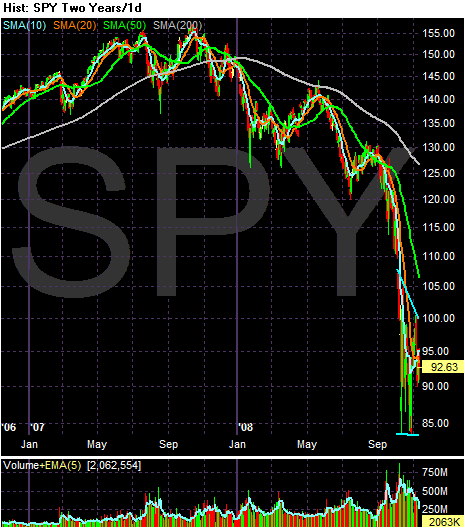
Let's start out. I'm working on the assumption the market is bottoming right now. Here's why:
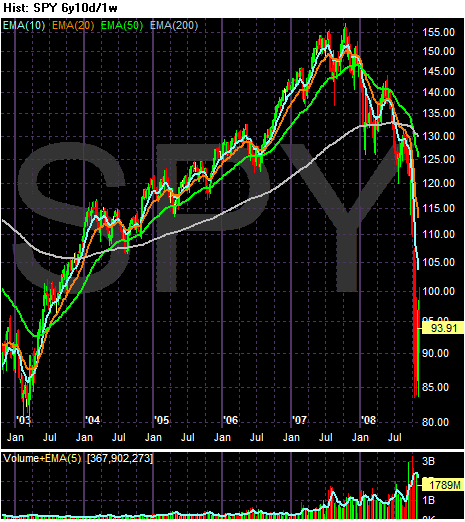
Above is a 7 year chart. It shows the last last rally completely. Notice the following:
-- About 87% of the increase in value (85 to 155) is now gone with the market trading at 93.91. In other words, the rally has been effectively wiped off the books.
-- The market formed a double top in 2007
-- The market has clearly broken all upward trend lines.
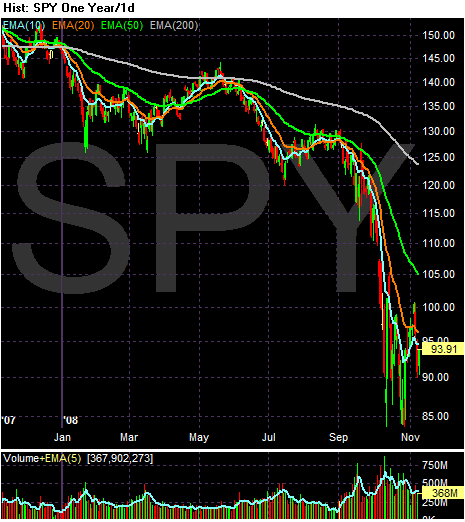
Above is a 1-year chart. The most important aspect of this chart is the severity of the sell-off over the last 2 months. That's a big drop.
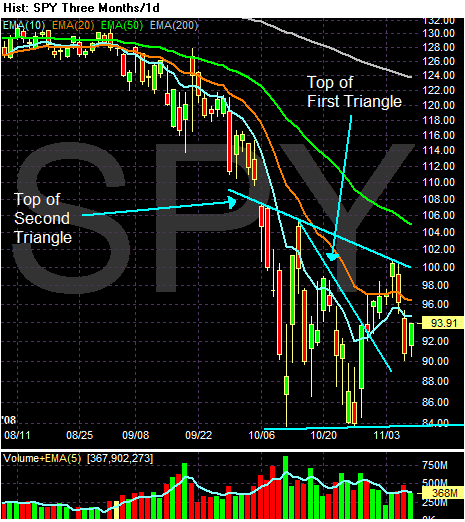
On the daily chart notice the following:
-- The shorter SMAs are moving into a more neutral position. The 10 day SMA actually increased recently and the 20 day SMAs degree of downward movement is decreasing.
-- Prices have fluctuated around the 10 and 20 day SMA for the last week or so.
-- Prices are still clearly within a range
-- A triangle pattern clearly exists
Now, let's consider the macro economic environment right now. We have a new president. The market is waiting to see what he will do. We've had coordinated action from other countries to stem the tide of the credit crunch. There is talk of a second fiscal stimulus bill. In other words the people who can take action are doing so. Also remember the employment is typically a lagging. That means that while Friday's employment report was terrible it could be signaling the beginning of the end to he contraction.
Above is a 7 year chart. It shows the last last rally completely. Notice the following:
-- About 87% of the increase in value (85 to 155) is now gone with the market trading at 93.91. In other words, the rally has been effectively wiped off the books.
-- The market formed a double top in 2007
-- The market has clearly broken all upward trend lines.
Above is a 1-year chart. The most important aspect of this chart is the severity of the sell-off over the last 2 months. That's a big drop.
On the daily chart notice the following:
-- The shorter SMAs are moving into a more neutral position. The 10 day SMA actually increased recently and the 20 day SMAs degree of downward movement is decreasing.
-- Prices have fluctuated around the 10 and 20 day SMA for the last week or so.
-- Prices are still clearly within a range
-- A triangle pattern clearly exists
Now, let's consider the macro economic environment right now. We have a new president. The market is waiting to see what he will do. We've had coordinated action from other countries to stem the tide of the credit crunch. There is talk of a second fiscal stimulus bill. In other words the people who can take action are doing so. Also remember the employment is typically a lagging. That means that while Friday's employment report was terrible it could be signaling the beginning of the end to he contraction.
Subscribe to:
Posts (Atom)