Thursday, October 15, 2009

Getting it wrong about economic indicators entirely

- by New Deal democrat

(Sigh...) Is there anything about economic indicators that Mish can get right? Apparently not.

Now he's launched a broadside against ECRI's recession calls (begrudgingly acknowledging at the end the correctness of their Great Recession bottom call last March). Now, ECRI are Big Boyz and Gurlz, so they can defend themselves (and they have). What I want to do is look at what he says about economic indicators generally.

First of all, here's what he says about the yield curve:
A strategy to exit the market on the ECRI's recession call is better than nothing, yet it leaves a lot on the table compared to a strategy of getting the hell out of the way when the yield curve inverts.
....
it's important to be fair. Inverted treasuries only predict recessions, they do not give "all clear" signals.
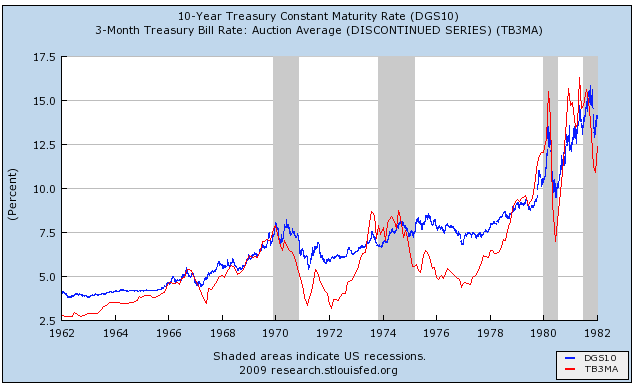
Actually, while the yield curve is generally a good predictor of the economy, in times of inflation it actually has a better record giving "all clear" signals than when it inverts. Mish doesn't supply the actual graphs, but I will. Here's the 10 year vs. the 3 month from 1961-1980:

and here it is from 1980 to the present:
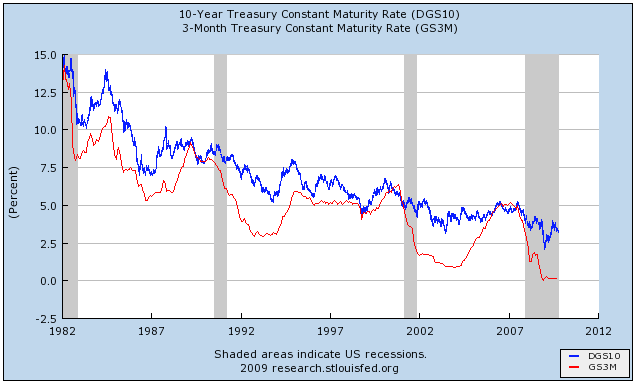
Had you predicted recession one year later every time the yield curve inverted, you would have had a false signal in 1966 and again in 1968. On the other hand, in times of inflation had you predicted recovery one year later every time the yield curve reverted to normalcy with at least a 1% difference between the long and the short bond, you would have had a perfect record.

In deflation the picture is more complicated -- an inverted yield curve, as in 1928-29 and 2007, means death, whereas a positively sloped curve only predicts recovery in the presence of abating deflation -- as in 1933 and now. (and no, deflation isn't deepening, not just as measured by the regular CPI. I debunked Mish's claim about the Case Schiller-CPI, showing that the CS-CPI also shows abating deflation compared with the bottom early this year, here).

So, why did Mish claim that the yield curve can't give the "all clear" sign? Maybe because it completely undercuts the narrative that caused him to miss a 3500 point (+55%) bull move in the DJIA during the last 7 months.

So what indicators does Mish think are worth following? Here's his conclusion:

This is what I see now: In spite of the change in the stock market, unemployment is high and rising, foreclosures are high and rising, banks are not lending, consumers are not spending, and the government is the buyer of only resort for mortgages. The deleveraging process continues while banks continue to tighten credit and finally, commercial real estate is imploding.

Those "real economy" conditions are not the makings of a strong recovery, perhaps not any recovery.
Well, since Mish is interested in debunking poor indicators, how about we return the favor and look at his?

1. "unemployment is high and rising"

Gee, just like at the end of every prior recession and at the beginning of every prior recovery. Leading indicator? Ummm, no.

2. "foreclosures are high and rising"

Well, there aren't good national charts going way back, but here's a nice one from California:

Gee, I wasn't aware that 1995 was the peak of the recession. Leading indicator? Ummm, no.

3. "banks are not lending"

Again, exactly like at the end of every prior recession and frequently well into the subsequent recovery. Leading indicator? Ummm, no.

4. "consumers are not spending"

Now this graph of Personal Consumption Expenditures shows that usually consumer spending does uptick before the end of recessions, but now it's ... ummm ... also upticking. Leading indicator? Ummm, well actually, yes. It's just showing the opposite of what Mish claims.

5. "finally, commercial real estate is imploding"

Again, exactly like the end of every prior recession and at the beginning of a number of prior recoveries, including the last two.
Leading indicator? Ummm, no.

Mish's conclusion: "Those "real economy" conditions are not the makings of a strong recovery, perhaps not any recovery"

The truth: Mish is 0 for 5. A whopping 4 out of 5 are proven lagging indicators! The fifth, which is a leading indicator, he gets completely wrong. He's also flat out wrong about the implications of a positive yield curve as well. If he were right, recessions would have continued in 1975, 1983, 1992, 2002, and on and on -- instead of the recoveries which actually happened.

And let's not forget this classic bad call about rail traffic from June of this year in which Mish claimed: "Year over Year Percent Change - 13 Week Rolling Averages … are still moving lower, with no apparent end in sight", a call which almost exactly marked the bottom of that very* trailing indicator (*which was also borne out by the week over week averages on the very same page).

Like I said at the beginning: Is there anything about economic indicators that Mish can get right? Apparently not.

(Sigh....)
--------------
Meanwhile, Prof. Paul Krugman has jumped on the bandwagon, saying:
[I]n a zero-interest rate world ... conventional indicators don’t mean what they usually mean..... So historical correlations, to the extent that they exist ... can’t be counted on to prevail. There’s really no alternative to making fundamental analyses of the macro situation.

Huh?!? Even Homer nods, and here, the good Nobel-prize-winning professor has not just nodded, but completely lost his memory. To begin with, as I've reminded the professor on his own blog, the available data indicate that it is likely that the LEI's would have functioned correctly during the Great Depression, including the 1929-32 collapse.

Further, the LEI's are supposed to call turns in the economy 3-6 months out. The LEI's began to turn in April, when the economy was still in free-fall. Now most economists agree that the recession ended (even if employment still stinks) sometime during the summer -- i.e., 3-5 months later. But don't take my word on it -- take the word of a guy named ... Prof. Paul Krugman. Here's what he said just one week ago:

it’s fairly clear that the official records will eventually say that the recession ended in the summer of 2009.
In other words, Krugman's assertion that the LEI's don't work in a zero-interest rate world isn't just undercut by looking at the likely LEI results from the 1930's. It is undercut by his own analysis of the present, which he reiterated only one week ago!

10 comments:

Constant Learner said...

I made the switch from Mish to here some months ago when I found out that he was mainly a permabear and I don't regret it. And he deleted my comments on his ECRI thread because I said I was doubting his analysis.

Douglas McElroy said...

And this is why I came to love the prog. blogosphere. I read a pretty wide range of econo blogs, from Mish and Denninger to Krugman (and here, obviously). Try to weed out confirmation bias, you know. But I don't have the expertise to know when a seemingly sound argument isn't. As an engineer I am a sucker for graphs... So thanks for this. I am, by temperament, kinda doom-n-gloom. You and Bonddad (who I have been reading since his days at DKos) have been consistently challenging that sentiment the last month or so, and with precisely the sort of arguments I have to respect - ones backed up by numbers and statistical and historical analysis. I've been having a hard time accepting the recovery (I am worried about the consumer and all the bad debt still to be realized), but I think this post just pushed me over the edge about the short to medium term situation.

Which means the market just reached it's top :) And no, I am not going to use this as trading advice, don't worry.

Thanks for your work, and thanks, Bonddad, for getting together such a solid crew.

olephart said...

Just an observation as to the yoy rate of change in PCE, in all prior recessions the PCE never actually contracted. They went from less positive to more positive. Thus far they've gone from more negative to less negative. At the beginning of each of the past recoveries the yoy PCE has been at least a positive 3% and we have yet to make it to 0%. While the direction of change is correct, the absolute values are still negative thus it is not a true uptick just yet.

kfunck1 said...

Come on man, you can't use a chart of foreclosures that ends in 2006 to justify your argument. That's like charting a route of the Titanic and stopping halfway across the Atlantic and proclaiming it a successful voyage.

William Servator said...

I see what you're saying with the lagging indicators, but I also think I see what Mish is trying to say. If you think about basic aggregate demand, it is comprised of Consumer Spending, Investment, Government Spending, and Net Exports.

Consumer Spending has risen a little, but that could easily be purchases of durable goods that could not be postponed any longer (see your PCE graph between 73-75). Continued uncertainty in the employment market will keep this as well as investment low.

Investment is understandably down (it always is in recessions). Further, with home values still depressed and many bankers still reeling from the losses endured due to speculation on housing prices. The largest asset of most households (typically borrowed against) isn't worth nearly as much.

The depreciation of the dollar is helping Net Exports to increase but it's not enough to offset the loss of domestic production (see http://research.stlouisfed.org/fred2/series/BOPBCA?cid=125).

So the point is each of these separately is a lagging indicator, but together they can paint a picture. Recoveries are not timed events; they have to be sparked by something. If not from one of these numbers where would a recovery come from?

SilverOz said...

I am in the middle on this one. While Mish is quite obviously wrong here, I am not so sure of Krugman. I do believe that so much has changed in the economy that much of the old data isn't of much use. I also believe that although the data has moved up from a panic low, that doesn't mean the data are signaling an actual recovery, as opposed to a bounce off a low and potential stagnation.

Finally, while unemployment is obviously a lagging indicator, that doesn't mean that high unemployment cannot effect the economy negatively and drastically reduce our growth potential going forward.

New Deal democrat said...

Constant Learner, Doughlas McElroy:

Thanks. Mish has a very thin skin. He lashed out at Tim Iacono of The Mess that Greenspan Made, when Tim pointed out that he was the originator of the CS-CPI. He refused to post Bruce Webb's rebuttal of a Social Security screed in his comments.

Olephart:

PCE is up 3% from about 10 months ago. That's positive.

Kfunck1:

Obviously you are correct about foreclosures now. My point was that they can be expected to lag this recovery, just as they lagged the last one. Hence the graph I chose.

SOz:

Krugman should have concluded by saying, "These are (nearly) unique circumstances, so traditional indicators might not work, we'll have to wait and see" as opposed to "so therefore we should ignore them."

In essence, Krugman was saying, "We don't know." Well, "we don't know" doesn't mean "your indicators are wrong."

kfunck1 said...

I understood that, but point taken indeed. Thanks for the postings.

Dragonchild said...

The big question is if and if so, how different this recession is from others. I think there's pundit pressure to be the one to make the wild and accurate prediction. Krugman's also a pundit, but in addition to that he has been alarmed at just how quickly everyone felt relieved -- in particular, rumblings that the Fed will increase rates to "control inflation" (WTF guys are you CRAZY) got him justifiably spooked. So, I suspect he may think the ends justifies the means and is trying to get people scared again, in a good way.

As for how this recession's different, that's also been discussed here. NDD makes a compelling case, but even without it I can plainly see we're recovering from the recession.

What's different is that service employment got hit hard this time around. When that happened to industry, industrial jobs stagnated. . . and stagnated. . . and stagnated.

Service has been the main driving force in employment since the 40's. If the same thing happens to it, it's a truly terrifying situation. What will take up the slack? Without some proverbially useless hole-digging jobs, our next generation of workers will become a "surplus population" in the worst sense: the economy won't need them to exist.

SilverOz said...

Which gets us back to my point that technology is becoming the game changer in job creation (negatively now) and that we need to take an entirely new approach to our current economic policy regime (and support system).