Tuesday, March 9, 2010

... and a Turning Point for Unemployment

- by New Deal democrat

Yesterday I discussed how virtually every indicator I can find (with the possible exception of construction) points to now being the turning point for jobs.

In particular I discussed how data about the duration of unemployment is coincident with payrolls. Well, the same data series has something interesting to show about the unemployment rate as well.

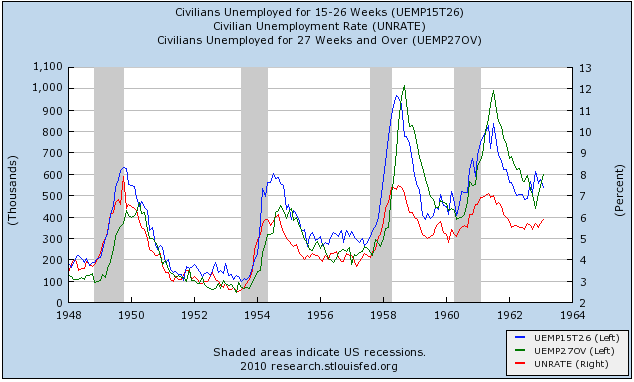
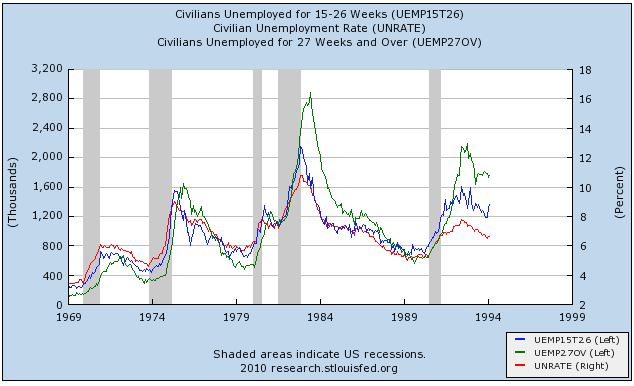
In the graphs below, the blue line is unemployment of 15-26 weeks' duration, the green line unemployment of over 26 weeks, and the red line is the unemployment rate. Here it is for 1948-1963:


and here it is for 1969-1994:

and here it is for the last 10 years:
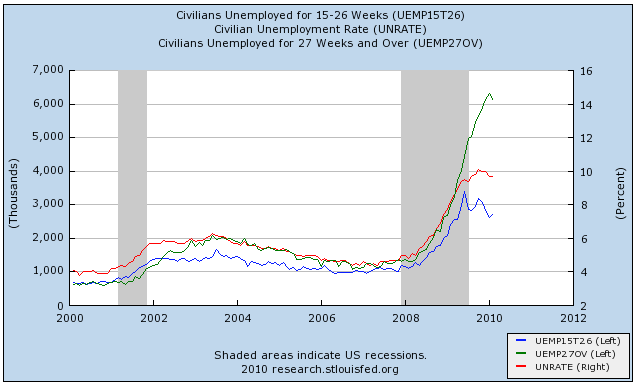
Note that in all prior cases, unemployment peaked before or certainly no later than the green line. As I said yesterday, it is not certain that the February decline in unemployment of 27 weeks' or longer duration means that January was the top, but it certainly suggests that the top is being formed.

In other words, it looks like the 10.2% unemployment of October was the real deal -- the peak unemployment rate. If so, while this may have been a "jobless recovery" up until now, it has been far more like the brief (6 month) 1992 recovery than the terribly long 21 month one of 2002-03.

5 comments:

brodero said...

The U6-U3 spread is now 7.1. The High was also in October at 7.3. The spread is about to go negative on a year over year basis next month which portends not only will the
headline unemployment rate (U6) start going down but the longer term unemployed and discouraged (U3)will go down also....

Dragonchild said...

That's good news; ergo, it must be wrong. Very serious people told me so.

brodero said...

Well...i am not a serious person...so I will represent the silly side....

Anonymous said...

Seems like Mark Zandi is off the doomer wagon for at least the next 2 months. Apparently May and June are the big months for him.

Headhunter212 said...

another link for you to consider: SHRM LINE sruvey as a leading indicator for hiring.

SHRM’s Leading Indicators of National Employment (LINE) report tracks trends in the labor market on a monthly basis, including hiring projections released one month ahead of the Bureau of Labor Statistics (BLS) Employment Situation report. Exclusive metrics also include new-hire compensation trends and recruiting difficulty, as well as job vacancies in exempt and nonexempt employment.

http://www.shrm.org/Research/MonthlyEmploymentIndices/line/Pages/default.aspx