Prof. Brad Delong is the latest prominent economist to label the period of Hard Times we are in a "depression." Prof. Paul Krugman has suggested several times that the period we are living through may be comparable to the post-1873 "Long Depression" that may have lasted over 20 years. Prof. Delong had previously insisted on 10%+ unemployment to label a period a "depression" but acknowledged admittedly that he was "moving the goalposts" to 9%+. He thereupon relabeled the "great recession" and our subsequent recovery, "The Little Depression."
Previously I have discussed the inadequacy of economic business cycle terms. To economists and other financial professionals, "Recession" and "recovery" mean, respectively, declining economic activity and increasing economic activity (that has not yet reached its previous peak). To ordinary citizens, however, "recession" conveys hard times, whereas "recovery" means the beginning of good times. In other words, one group measures the change in activity, while average citizens are more concerned about its level. It would be really helpful if professionals developed and agreed upon terms that reflected the common concern with the level of activity as well. The ad hoc usage of depression and the refusal to apply the previously agreed term of recovery for improvement off the bottom clearly show the need for such vocabulary.
But let's accept that, in terms of the level of unemployment and economic activity, the period since December 2007 to the present should be called a "depression."
If that is true, however, then why shouldn't the period from 1974 through 1987 also be labeled a depression?
The unemployment rate throughout this period was consistently high. Unemployment exceeded 6% from October 1974 through August 1987 for all but 4 months in 1978 and 9 months of 1979. It exceeded 7% from December 1974 through July 1978 and with one exception again from May 1980 through October 1986. It exceeded 8% from all during 1975 and again from november 1981 through January 1984. Finally, there was 10%+ unemployment from September 1982 through June 1983 (vs. only one month of 10%+ unemployment in 2009).
All of those periods are longer than the period of elevated unemployment since December 2007, as shown in this graph of the unemployment rate for the respective two periods:
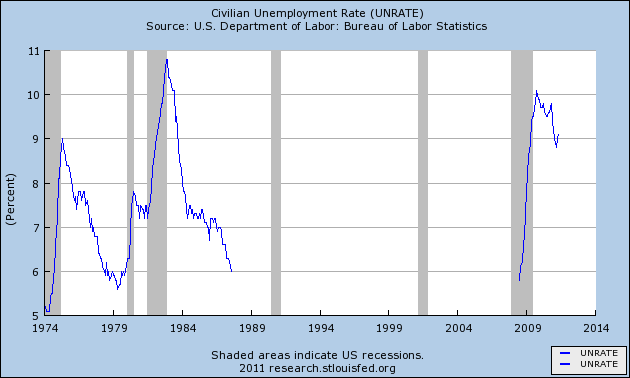
Thus, only by specifically selecting 9%, as to which there were 18 months of higher unemployment in 1982-83 vs. 24 months from 2009 to the present can Delong make the case that the current period is worse.
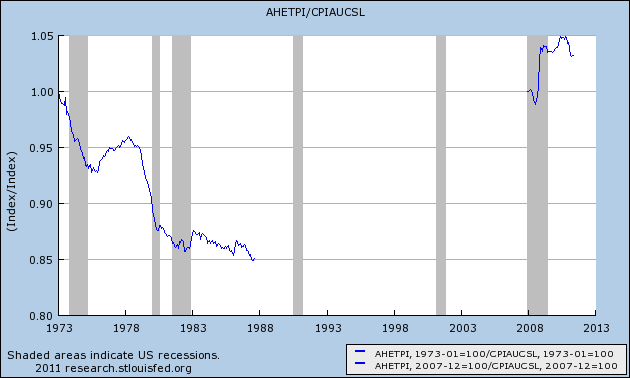
If unemployment was at least as bad during the 1974-87 period as the present, real income looks even worse. Between 1974 and 1987, real inflation adjusted average hourly earnings decreased about 16%. In contrast, since Decmeber 2007 real hourly earning have actually increased:
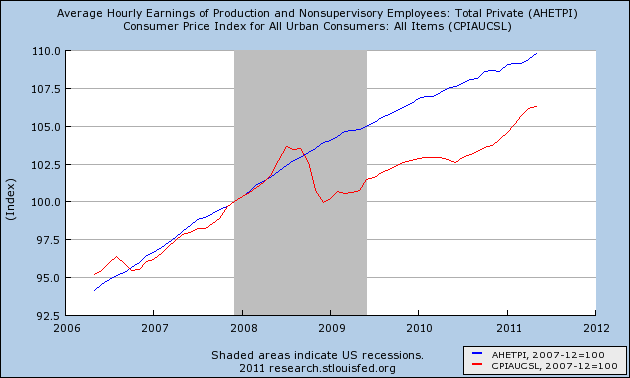
The reason, incidentally, for the counter-inuitive result since 2007 has to do with the stickiness of wages. Energy prices had a one-off unreplaced decline in the latter part of the "great recession" while wages continued to slowly improve:
Finally, let's turn to real GDP. Since the end of World War 2, over the long term the trend of real GDP has gradually declined, from roughly 4% growth over 10 years, to 3%, and recently to 2%, as shown on this graph (h/t Christian Science Monitor):
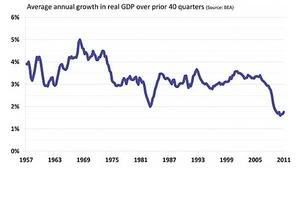
With this slowly declining long term trend in mind, there was a 2-stairstep decline off previous trend during the 1974 - 1987 period, of about 13%. By comparison, the current decline off previous trend is about 10%:
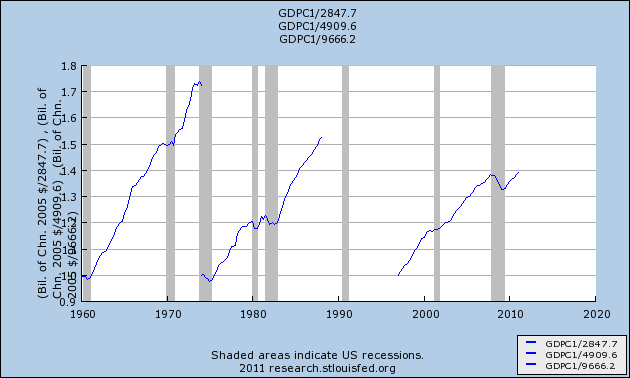
In summary, the 1974-87 period is about the same in terms of the unemployment rate so far, but was considerably worse both in terms of real hourly income and decline from previously trending GDP. So if Profs. Krugman and Delong believe we are in a depression now, why weren't we in a depression then?

