Many if not most times you will see me cite year-over-year trends in economic data. This is because prior research has been based on YoY trends, and also because many, many data series have marked seasonality. So, for example, with rail traffic you simply can't compare wintertime post-Christmas carloads with late summer or autumn carloads. Similar issues exist for tax withholding and for state tax receipts. Thus the only valid way to see a trend is YoY.
But where there is no seasonality, or where the data has already been seasonally adjusted, YoY comparisons lag turning points. For example, weekly initial jobless claims are seasonally adjusted by the BLS. Waiting for a YoY change there in 2009 would have completely missed the turning point. YoY initial claims did not turn positive (i.e, lower) until November 19, 2009, even though the bottom was made on the week of March 28, 2009.
Which brings us to housing prices. Note: I'm discussing nominal prices here, not "real" inflation adjusted prices. Yesterday the Case-Shiller housing indices for June were released. Here's a graph of the Case-Shiller 20 city index for the last five years:
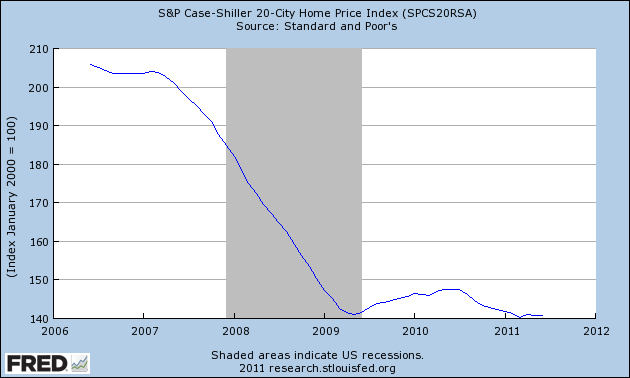
The Case-Shiller data in the graph above IS seasonally adjusted. So we don't have to wait for YoY changes to make valid statements about the data. Well, here is the data for the 20 city index shown above for the last 6 months:
2011-01-01 141.75
2011-02-01 141.31
2011-03-01 140.30
2011-04-01 140.94
2011-05-01 140.84
2011-06-01 140.76
As I pointed out yesterday, the variation in the index over the last 6 months is less than 1%, and on a seasonally adjusted basis we have not made a new low in 3 months. In fact we are less than 1% below where this index stood in mid- 2009 (before most of the $8000 housing credit distortions kicked in).
Yes, it's only nominal and not "real," and by no means is it clear that March will prove to have been the absolute bottom, but even if there is some further deterioration, we are probably near the bottom in nominal (not "real") housing prices. In fact the bottom in housing prices may be staring us right in the face.
----------
P.S.: It may be tempting to think that the overhang of foreclosures will drive house prices further down. But consider that the same overhang existed in January. It existed in February. It existed in March. And April, May, and June, too -- but it did not drive prices down in those six months. Is anything different about the foreclosure overhang now than during the last half year?


11 comments:
Might the overhang be reaching the market -- at least the large part in the hands of institutional people -- at about the rate it is being taken out, so as to keep prices from falling farther? I need go a very small distance to find property that was foreclosed a year ago and is not for sale, though it was carefully winterized.
A key question concerns whether there will be an upturn when the bottom is reached. I see little evidence of pent up demand for new or existing housing so long as the unemployment remains stagnate and the banks do not come to some sort of agreement on opening their coffers.
First, can you explain what you mean by nominal and "real"?
And speaking to the lack of pent-up demand, do you disagree that housing prices and wages need to be in sync, such that a median wage can afford a median turn-key house. Right now in many communities, a median wage can only afford a fixer, what is euphemistically called "a contractor's special."
Anonymous@9:27... Nominal is the list price ("name"). Real is the inflation adjusted price.
Real prices are the only ones that matter, but nominal prices are the ones that people have easy access to and make decisions based on. It can make you crazy.
Anecdotally, I'd say yes. In Chicago, somebody I know recently sold their condo. Not only were they able to sell it quickly, they actually had trouble finding a new place to buy where they were moving to. In talking with them I discovered an oddity of the market right now.
Basically what it boils down to is that there's a glut of low-end properties, foreclosures, fixer uppers, etc. And there's similarly a glut of high-end properties ($600K+). But in the middle of the price range around $200-300K for decently maintained places, there's actually a relatively small supply.
Presumably, now that we seem to be hitting a bottom, it will make more sense for people to invest in those fixer uppers, because they'll have a market to sell them into. So it seems like we're at the start of the turnaround here.
Provided the economy stays on track, I expect that it will turn out home prices overshot a bit on the decline. So we'll see a supply/demand crunch in fairly short order in more popular places to live, driving up prices more sharply, and driving demand for construction jobs as well.
George Phillies: Yes, that's a fair speculation.
Shlenny: I do think there is pent-up demand in the form of Millenials living back with mom and dad in their 20's.
Anon at 9:27: What Odysseus says. Let's say a house is sold for $100,000 now. A year from now an identical house is for sale at at $101,000 but inflation has gone up 4%. The house price bottomed nominally at $100,000, but in real terms its price has declined about 3% more in the following year. In terms of wage parity, housing now costs about what it did in 1990 and 2000. To reach the mid-1990s lows it needs to go down about another 20%, which it might in the next few years - simply by not keeping up with inflation. Hope that helps.
"Is anything different about the foreclosure overhang now than during the last half year?"
Maybe not, but don't forget demand. Even if foreclosure supply is relatively stable, demand does seem to be slipping further. See: Mortgage Purchase Activity "near 15-year lows"
NDD, some good economists are predicting an essentially 100% chance of a recession, either outright or growth, with the odds split roughly evenly between the two. There's also a significant risk of a financial disruption in the EZ, which will impact the financial system, making credit even scarcer and making it possible that this will not be just a 2 quarter recession, but a deeper one.
How do those odds influence your bottom call?
--Charles
On the other hand, I just refinances. My banker noted that some of the competitors are taking years to file foreclosures, during which time the former owners have housing for free.
Charles...EZ issues sound to be problem 3.
There is _some_ pent-up demand. There are many people that simply can't move (but would like to) because they are underwater. ie. "strategic defaults" that have decided not to strategically default. This won't improve until housing prices start to rise again.
@anon 12:51. All the language that makes house prices rising sound like an improvement is misleading. Houses prices need to fall until they are affordable for people with jobs, "strategic defaults" or not.
Post a Comment