Tuesday, March 13, 2012

The bifurcated jobs recovery

- by New Deal democrat

Karl Smith at Modeled Behavior yesterday wrote a couple of excellent posts wherein he divided the US workforce into two parts: (1) "goods and government" vs. (2) private service jobs. He pointed out that:
Goods and Government are what we might have thought about as backbone jobs. These are police officers, fire fighters, school teachers, factory workers, construction workers. When you think of a stereotypical 1950s American, they are doing one of these jobs.
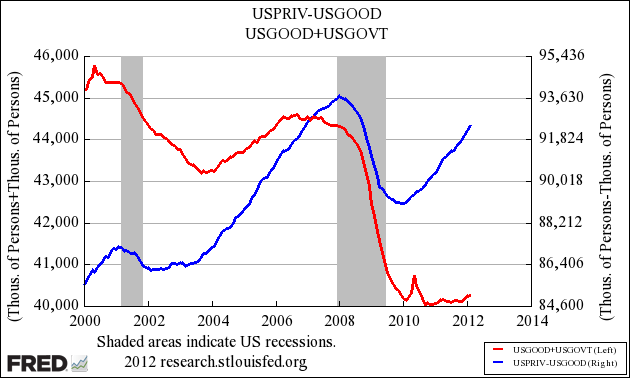
He noted that it is this group - public employees, construction workers, and manufacturing workers - who have seen little or no improvement since the bottom of the recession. Here's his graph, showing the number of "goods and government" worker jobs in red (left scale), and private service jobs in blue (right scale):


That got me thinking. One of the signature differences between the "Great Recession" and other post-WW2 recessions is how much it impacted private service jobs. To compare, here are the same two categories of jobs, "goods and government" (red) and private service jobs (blue) showing the relative impact of the two previous worst recessions since WW2 - 1974 and 1981-82 - on those categories, by showing the number of jobs in each gained or lost since their peaks just before the 1974 recession:
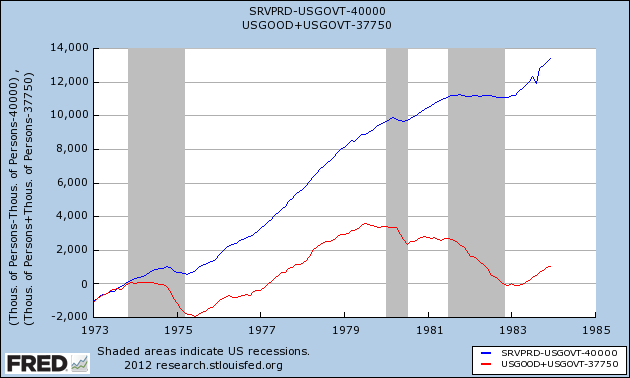


You can see that private service jobs were barely scratched in 1981,and actually increased during the 1974 recession!

Now let's look at job losses and recoveries for the two sectors in the Great Recession. The difference between this graph and Karl's is that both categories are shown on the same scale, and show the number of jobs lost since their respective peaks immediately prior to this recession:
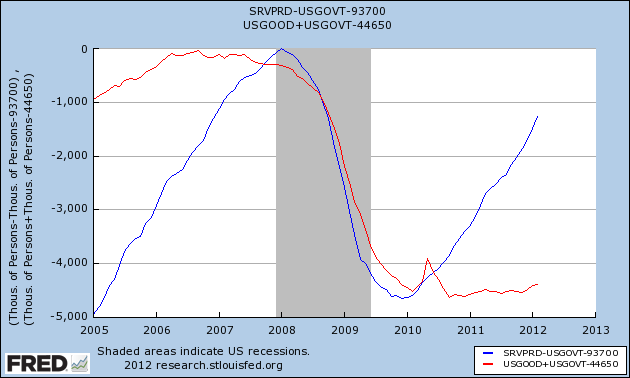


Unlike every other post-WW2 recession, private service jobs were slammed in this last recession. As many private service jobs were lost - about 4.5 million - as were lost in the goods and government sectors. Further, the private service sector is having close to a V-shaped recovery. Three-fourths of all private service jobs lost during the recession have already been made up. If the current rate continues, by the end of this year there will be no remaining job losses in that sector (although it will not have caught up with population growth).

Virtually the entire 5,000,000+ continuing job losses are in manufacturing, construction, and government. Manufacturing has long-standing issues of automation and offshoring, and it can be debated how much of its long-term losses are due to each factor.

Construction and government job losses, however, are another matter entirely, reflecting a colossal and unnecessary waste due to ideological political failure. We need something like $3 trillion in infrasctructure repairs to bridges, sewer and water mains, and the electric grid. We have several million idle construction workers. And we could finance the infrastructure repairs that would make this country so much more competitive and pay for itself multiple times over (see, e.g., Erie Canal and interstate highway system) by issuing debt at 2% in the open market. Further, whatever one's opinion regarding government inefficiency, police officers, firefighters, and teachers are not by any stretch its primary source -- and yet those are the government workers who have been most impacted.

If it were not for this utterly unnecessary waste, we would not have to pay for so many food stamps, we would not have to fund so much extended unemployment compensation, we would have the benefit of the professional and constructed infrastructure, and there would be probably a million or more persons employed in Karl Smith's "backbone jobs." Those employees would be supporting their families, and paying withholding, property and income taxes, with all of the resulting positive multiplier effects throughout the economy.

Instead here we are, almost three years since the bottom of the recession, having made up less than half of the total jobs lost, tolerating a bifurcated jobs recovery.

7 comments:

Anonymous said...

$3 trillion in infrasctructure repairs? It's a long leap between "infrastructure repairs" to making "this country so much more competitive and pay for itself multiple times over (see, e.g., Erie Canal and interstate highway system)". Repairs happen as needed. You don't need to go out and repair the heck out of everything just because there may be $100 in damage to every bridge. That's tax and spend math.

Anonymous said...

@anon 7:26:

Actually it makes lots of sense, see damage to roads, bridges being obsolete, and other infrastructure problems create a tax on individuals and businesses, by raising costs of vehicle repairs, raising the amount of fuel used and delaying people due to added congestion, and that's just from the transportation side of infrastructure.

In addition, infrastructure would put people back to work in construction, manufacturing, finance, engineering, and other fields, reducing unemployment and putting more money into people's pockets, thereby increasing consumption.

Its a win-win scenario

Anonymous said...

I lived in Ca. for 65 years. I had a union construction job where I spent 27 years with several employers. I could see early on that the retirement provided would not be sufficient even though my employer was contributing $3.00 per hour for my benitit. I wanted to invest in the stock market but was terrified by the volitity, so I bought real property starting with my first home at age 22. When I retired I had an retirement of $750/mo at age starting at 55.
5 years later I had a CDF fire fighter at my house for Thanksgiving. He told me that he had transfered to a new post (prisoner fire crews) for his final year before retirement so that his retirement would increase by $750/mo. He was making $100,000 a year and would retire with a 3% X 30 years service benifit or $90,000 a year. Plus 2%/yr cost of living increase. At age 62 he will be collecting over 101,000 each year from the taxpayers of Ca. The real laugh here is that he is a Tea Party advocate for the end of government paid welfare. This is the situation we have with public employees who can't be fired. The difference in between public and private is off the chart.

Anonymous said...

A few years ago, my kids and I spent two summers crisscrossing America. America's infrastructure problems are real and far greater than $100 per bridge. The last time America invested in its infrastructure was in the 1930's, and most stuff is that old. Repairs have not been made as needed. It is long past time to repair and upgrade. America should not simply repair but take this opportunity to consider what we want for the next 100 years, for example, light rail. Simply repairing car-based infrastructure is poor planning for the demands of the future.

Anonymous said...

"Construction and government job losses reflect a colossal and unnecessary waste due to ideological political failure?"

You can't be serious.


"We need something like $3 trillion in infrasctructure repairs to bridges, sewer and water mains, and the electric grid."

Sure, we could keep repaving those roads in my area over and over again to keep people employed, just like how FDR paid countless thousands to rake leaves and put gravel down and call them roads. And all that we create more inflation, risk even a larger future jolt in the bond market, and put the currency risk.


."We have several million idle construction workers. And we could finance the infrastructure repairs that would make this country so much more competitive and pay for itself multiple times over (see, e.g., Erie Canal and interstate highway system) by issuing debt at 2% in the open market. "

Yeah, repaving roads and replacing bridges will make us so much more competitive...LOL... and pay for itself once, much less "multiple times over"... lol. The vast majority of such projects nowadays are politically motivated and bring negative returns.

" see damage to roads, bridges being obsolete, and other infrastructure problems create a tax on individuals and businesses, by raising costs of vehicle repairs, raising the amount of fuel used and delaying people due to added congestion, and that's just from the transportation side of infrastructure."

The cost of vehicle repairs due to problem roads is not an issue in the vast majority of areas in the US. Replacing old bridges in most cases will do nothing but result in a more pleasing looking bridge. In most high traffic areas there is no space to add another lane, so it's not efficiency will be enhanced in most cases.

Hale Stewart said...

Dear anon

You might want to read the report from the American Socierty of Civil engineers, who give the US infrastructure a D- grade. The reason? It's in terrible shape. Of course, that would mean you have to stop spouting off Fox news talking points and actually think for yourself, which you're obviously incapable of doing. Why don't you leave the intellectual heavy lifting to those of us who are capable

Anonymous said...

Anon 7:37 makes a number of unexamined assumptions, the biggest one being that repairing infrastructure means simply repair without a thought to the changing demand on that infrastructure or the original, and possibly false assumption that led to the original design almost 100 years ago. So-called "repair" must involve planning for the next 100 years as well.

Mr. Stewart, as an aside, it is completely unnecessary to wear your ego on your sleeve. I would hope you would elevate the professionalism of your otherwise great blog by avoiding resort to personal insult by calling someone an idiot in 30 words or so (which, by the way, is so Dkos).